
Two Cheap Drugs, 70% More Life: The Longevity Breakthrough That Big Pharma Won’t Commercialize
In a quiet laboratory at UC Berkeley, scientists have done something extraordinary — and economically inconvenient. By combining two cheap, well-understood compounds, they extended the remaining lifespan of elderly male mice by 73 percent. The drugs cost pennies. The implications are worth trillions. And that, paradoxically, is exactly why no pharmaceutical company will touch it.
The Experiment That Changed Everything
The mice were old. Not middle-aged, not slightly past their prime — genuinely old. At 25 months, they were the murine equivalent of 75-year-old humans: frail, slow, cognitively dulled. The kind of old where every day is borrowed time.
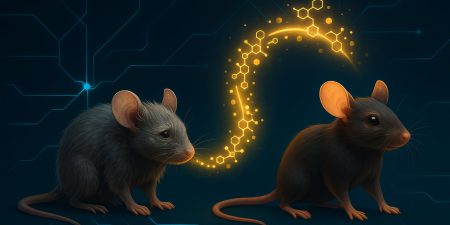
Cameron Kato and the team at Irina Conboy’s laboratory at UC Berkeley gave these elderly mice a combination of two substances: oxytocin (OT), the hormone popularly known for social bonding and love, and an Alk5 inhibitor (A5i), a compound that blocks an overactive cellular signaling pathway called TGF-beta. Neither substance is novel. Neither is expensive. Both have been studied for decades.
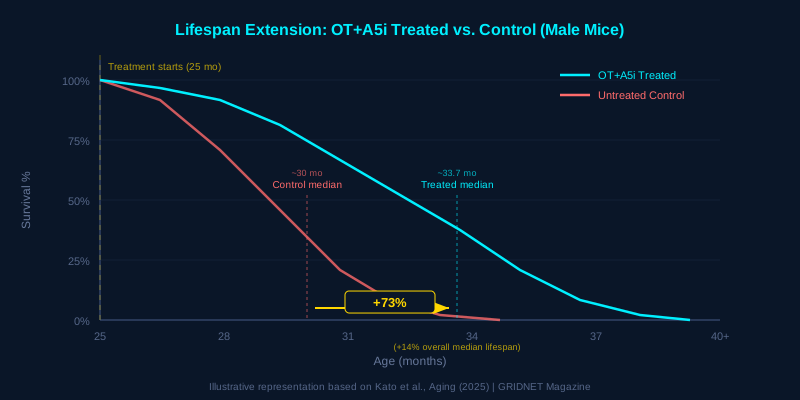
The results, published in the journal Aging, were staggering. Treated male mice lived 73 percent longer from the point of treatment than untreated controls, translating to a 14 percent increase in overall median lifespan. But the numbers alone miss the poetry of what happened: these mice didn’t just survive longer — they got younger. Muscle strength returned. Short-term memory improved. Blood protein profiles shifted toward those of younger animals. The biological clock, it seemed, could be wound backward.
How Two Cheap Molecules Outsmart Aging
To understand why this combination works, you need to understand two things that go wrong as we age — and how each drug targets one of them.
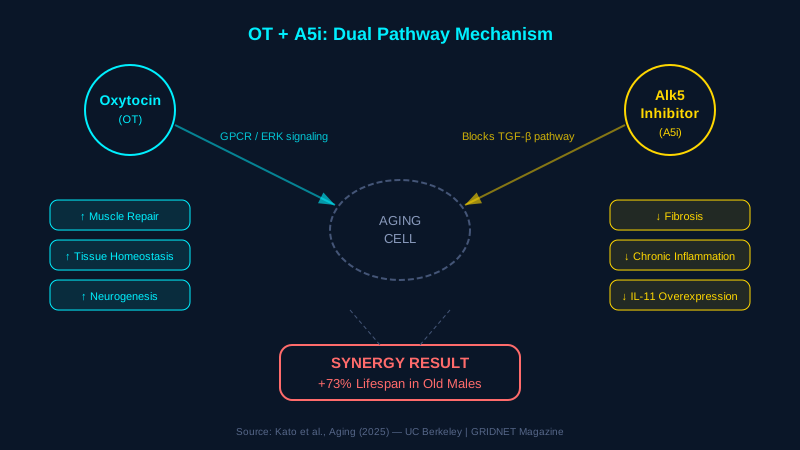
Oxytocin, the first component, is a hormone that naturally declines with age. Most people associate it with childbirth and emotional bonding, but its biological role is far broader. Oxytocin activates G-protein-coupled receptors and ERK signaling pathways that are essential for muscle stem cell activation, tissue repair, and neurogenesis. When oxytocin levels fall in old age, the body’s ability to repair itself quietly collapses. Supplementing it reactivates the repair machinery.
The Alk5 inhibitor targets a different problem entirely. As we age, the TGF-beta signaling pathway becomes chronically overactive, driving fibrosis (scarring of tissues), persistent inflammation, and overexpression of IL-11 — a cytokine increasingly recognized as a key driver of aging. Blocking Alk5 — the receptor that initiates TGF-beta signaling — turns down this inflammatory noise.
Individually, each compound produces modest benefits. Together, they create a synergy that neither achieves alone: simultaneously rebuilding the body’s repair capacity while removing the inflammatory signals that accelerate decay. It is, in essence, pressing the accelerator and releasing the brake at the same time.
The Sex Paradox
There is a catch, and it is a fascinating one. The 73 percent life extension occurred only in males. Female mice showed no lifespan benefit from the same treatment.
This is not entirely surprising — sex differences in aging are well-documented across species, from the fact that women outlive men in virtually every human society to the observation that caloric restriction produces different effects in male and female rodents. The Conboy lab notes that the OT+A5i combination does produce benefits in females at other life stages, including rejuvenation of fertility in middle-aged female mice. But for late-life lifespan extension, the effect was male-specific.
Why? The honest answer is that nobody yet knows. The researchers speculate it may relate to hormonal differences in how TGF-beta and oxytocin pathways interact with estrogen and testosterone signaling. It is a reminder that aging is not one disease but many — a symphony of decline that plays in different keys depending on sex, genetics, and history.
Your Dog May Get There First
While the Berkeley study advances the science of aging in mice, another story is unfolding that brings longevity drugs closer to reality — not in humans, but in dogs.
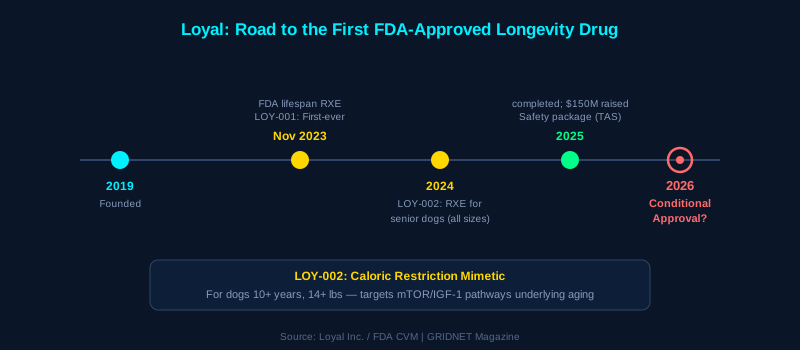
Loyal, a San Francisco-based biotech company, is on the verge of achieving something unprecedented: FDA conditional approval for LOY-002, a drug explicitly designed to extend the lifespan of senior dogs. If approved, it would be the first drug in history — for any species — to receive regulatory approval with lifespan extension as its primary indication.
LOY-002 is a caloric restriction mimetic: it targets the mTOR and IGF-1 pathways that underlie aging, replicating the well-documented lifespan benefits of severe caloric restriction without requiring animals to actually eat less. The drug is aimed at dogs over 10 years old weighing 14 pounds or more — essentially, senior dogs of almost all breeds.
The milestones have come fast. In November 2023, Loyal’s earlier drug LOY-001 (for large breed dogs) became the first longevity drug ever to receive FDA acceptance of a “reasonable expectation of efficacy” (RXE). LOY-002 followed with its own RXE in early 2025. By 2025, Loyal had completed the safety package required for conditional approval and raised over $150 million in total funding. A 2026 market launch is now the target.
The significance extends far beyond veterinary medicine. A conditionally approved canine longevity drug would establish the regulatory and scientific precedent that aging itself is a treatable condition — a philosophical shift that has eluded human medicine for decades. Dogs age faster than humans, making them ideal models for longevity research, and every data point Loyal generates makes the case for human applications stronger.
The $2.6 Billion Problem
Here is the uncomfortable truth at the center of this story. The OT+A5i combination that extended mouse lifespan by 73 percent uses two compounds that are:
- Well-characterized and widely available
- Off-patent or never patented in their relevant formulations
- Cheap to manufacture
- Already used in clinical settings for other purposes
This is, from a pharmaceutical business perspective, a disaster.
The average cost of bringing a new drug to market is approximately $2.6 billion. Pharmaceutical companies justify this staggering expenditure through patent protection — a 20-year monopoly that allows them to recoup costs and generate profit. But you cannot patent oxytocin. You cannot patent a well-known kinase inhibitor. There is no monopoly to be had, no exclusivity period to exploit, no pricing power to exercise.
The result is a structural failure in how humanity funds its most important research. The most promising longevity intervention discovered in years — one that uses compounds already known to be safe in humans — will not be developed by any major pharmaceutical company because there is no business case for it. The incentive structure of modern capitalism, which has produced miraculous drugs for cancer, HIV, and hepatitis C, simply breaks down when the molecules are too cheap and too well-known to be owned.
This is not a conspiracy. It is math. And it is the strongest argument yet for a fundamentally different model of science funding.
Enter Decentralized Science
The DeSci — decentralized science — movement was built precisely for this moment.
VitaDAO, the largest decentralized autonomous organization focused on longevity research, has deployed over $4.2 million across 24 research projects since 2021. With liquid funds exceeding $6 million and a community of 10,000 token holders governing through $VITA tokens, it represents a new model: research funded by public interest rather than private profit.
The mechanism is elegant. Researchers propose projects. Token holders vote on which to fund. Intellectual property is fractionalized through IP-NFTs — non-fungible tokens that represent ownership stakes in research outcomes. Anyone can participate. There are no boardrooms to convince, no quarterly earnings to protect, no patent portfolios to defend.
Molecule, another DeSci protocol, provides the infrastructure layer for these IP-NFTs, enabling researchers to tokenize their discoveries and trade them on open markets. The result is a funding ecosystem where the economic value of a discovery is determined by its scientific merit and public benefit, not by its patentability.
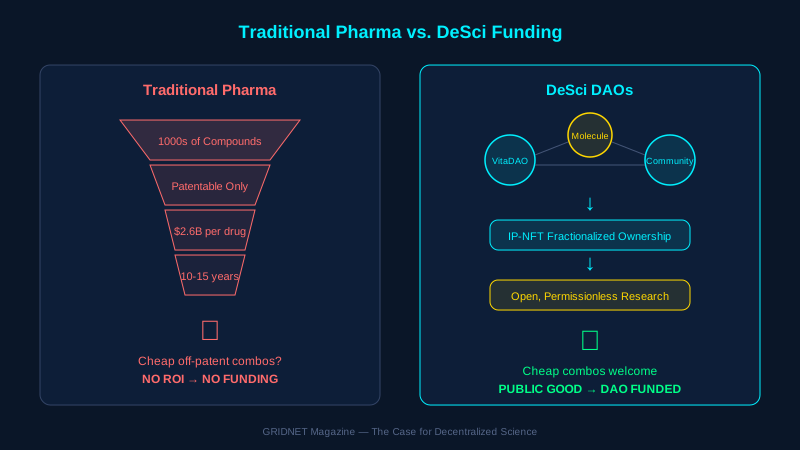
The OT+A5i longevity combination is a perfect candidate for this model. No pharmaceutical company will fund clinical trials for an unpatentable drug combination — but a DAO of 10,000 people who each stand to benefit from longer, healthier lives? They might. And the cost of a Phase I clinical trial — typically $1-5 million — is well within reach of the DeSci ecosystem’s current resources.
GRIDNET OS: The Missing Infrastructure Layer
Funding, however, is only half the challenge. The other half is coordination.
Clinical trials require enormous computational resources: statistical modeling, genomic analysis, patient data management, regulatory compliance tracking. They require secure, permissionless data storage that respects patient privacy while enabling global collaboration. They require coordination mechanisms that work across borders, institutions, and time zones without relying on a single corporate entity to manage everything.
This is where GRIDNET OS enters the picture — not as a longevity company, but as the infrastructure that makes decentralized longevity research possible.
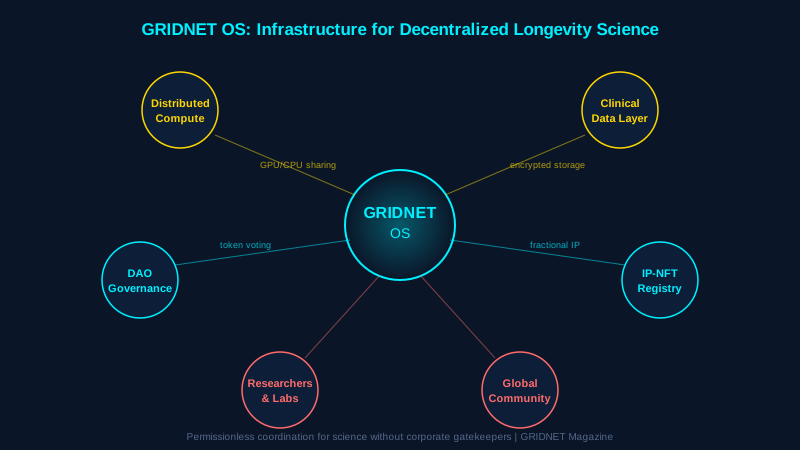
GRIDNET OS provides a permissionless operating system for distributed computation and coordination. Its architecture supports exactly the kind of work that decentralized clinical research demands:
- Distributed compute: GPU and CPU sharing across a global network, enabling the statistical and genomic analysis that longevity research requires without dependence on centralized cloud providers.
- Encrypted data layers: Secure, decentralized storage for sensitive clinical data — patient records, biomarker measurements, trial outcomes — accessible only to authorized participants.
- DAO-compatible governance: Infrastructure that integrates with token-based voting and IP-NFT registries, enabling research projects to be proposed, funded, executed, and verified entirely on-chain.
- Permissionless participation: Any researcher, any lab, any citizen scientist can contribute compute, data, or expertise without institutional gatekeeping.
The vision is not theoretical. The tools exist. What remains is the will to connect them — to build the bridge between a Berkeley lab that has discovered a 73% lifespan extension and a global community that wants to bring it to humans.
The Moral Arithmetic of Longevity
Let us step back and consider what is at stake.
Approximately 100,000 people die every day from age-related causes. That is roughly 36.5 million per year — more than any war, any pandemic, any natural disaster in human history. Aging is, by any objective measure, the largest cause of suffering on Earth.
We now have credible evidence that two cheap, well-understood compounds can reverse some of the most debilitating effects of aging in mammals. We have a company on the verge of proving to the FDA that lifespan extension is a legitimate pharmaceutical indication. We have a funding model — DeSci — that can support research that traditional markets won’t. And we have the computational infrastructure — GRIDNET OS — to coordinate this work globally and permissionlessly.
What we lack is urgency.
The Berkeley researchers will publish more papers. Loyal will (probably) get its conditional approval. VitaDAO will fund more projects. But the gap between a mouse study and a human therapy remains vast, and every year it takes to cross it is another 36.5 million lives that end as they always have — with frailty, decline, and death from causes we are increasingly learning to prevent.
The question is no longer whether we can extend healthy human lifespan. The question is whether we can organize ourselves — our funding, our computation, our governance — to do it before another generation runs out of time.
Decentralized science is not a utopian fantasy. It is a pragmatic response to a market failure that kills millions. The molecules are cheap. The infrastructure is ready. The only scarce resource is collective will.
The mice got 73 percent more life. The question for the rest of us is simple: what are we waiting for?
Sources: Kato, C. et al. “Sex-specific longitudinal reversal of aging in old frail mice.” Aging (2025). DOI: 10.18632/aging.206304 · Loyal Inc., FDA regulatory milestones (2023-2026) · VitaDAO governance reports · ScienceDaily, ScienceAlert, ScitechDaily reporting.
Disclosure: This article reflects GRIDNET Magazine’s editorial position on decentralized infrastructure for science. GRIDNET OS is developed by the same organization that publishes this magazine. Readers should consider this context when evaluating claims about GRIDNET OS capabilities.
References & Sources
- Kato, C. et al., “Sex-specific longitudinal reversal of aging in old frail mice,” Aging, Vol. 17, Issue 9, pp. 2689–2718, August 2025. [Aging-US / DOI]
- Kato, C. et al., PubMed: PMID 40848270, National Library of Medicine, 2025. [PubMed / NIH]
- Conboy, I.M. et al., “Rejuvenation of aged progenitor cells by exposure to a young systemic environment,” Nature, 433, 760–764, 2005. [Nature]
- Aging-US Editorial Office, “Sex-Specific Effects Found in New Anti-Aging Therapy for Elderly Mice,” Press Release, October 1, 2025. [Aging-US]
- University of California, Berkeley, QB3 Institute — Conboy Laboratory. [UC Berkeley QB3]
- Reuters, “Cheap hormone combo extends mouse lifespan by 73%, UC Berkeley study finds,” December 2025. [Reuters Health]