

The Accelerando Begins: Why February 2026 May Be the Month AI Crossed the Exponential Threshold
In the space of a single week, China shipped three frontier-class models at a fraction of Western costs, NASA let AI drive on Mars, and the monopoly thesis of artificial intelligence quietly collapsed. Welcome to the accelerando.
The Italian futurist composer Luigi Russolo once argued that the industrial age had given humanity an entirely new category of sound — the roar of engines, the clatter of factories — and that art had to evolve or become irrelevant. A century later, we find ourselves in an analogous moment, except the new sound is not mechanical. It is computational. And in February 2026, it became deafening.
In the span of ten days, DeepSeek released V4 — a one-trillion-parameter model with a million-token context window, running on hardware you could buy at a computer shop. Alibaba unveiled Qwen 3.5, an open-weight model with 397 billion parameters that matched or exceeded GPT-4 on standard benchmarks. ByteDance dropped Doubao 2.0. And on Mars, 225 million kilometres from the nearest human programmer, NASA’s Perseverance rover completed drives planned entirely by generative AI.
Each of these would have been front-page news in isolation. Together, they suggest something more profound: the exponential curve of AI development is no longer a projection. It is an observable phenomenon, and we may be living through the inflection point.
I. The DeepSeek Shock, Repeated
In January 2025, DeepSeek’s R1 model sent tremors through Silicon Valley. A Chinese lab, operating under US chip export restrictions, had produced a reasoning model competitive with the best Western offerings — at a reported training cost of $5.6 million. OpenAI had spent over $100 million training GPT-4. Wall Street noticed. Nvidia’s stock wobbled. The narrative that frontier AI was an American monopoly, sustained by American capital and American chips, developed its first serious crack.
Thirteen months later, DeepSeek V4 is not a crack. It is a demolition.
The numbers are staggering. One trillion total parameters, orchestrated through a Mixture-of-Experts architecture that activates only the relevant subset for any given query. A context window exceeding one million tokens — enough to ingest an entire codebase, a novel, or a year’s worth of corporate email in a single pass. Three architectural innovations that the research community is still digesting:
Manifold-Constrained Hyper-Connections (mHC) — a rethinking of how information flows between transformer layers, yielding what early benchmarks suggest is a 15-20% efficiency gain over standard architectures.
Engram conditional memory — a system that places frequently accessed data in faster storage tiers while archiving less-used information, mimicking (crudely, but effectively) the way biological memory prioritises recent and important information.
DeepSeek Sparse Attention — an attention mechanism that achieves the million-token context window while cutting computational costs by roughly half compared to standard attention.
But the number that matters most is not a parameter count. It is a price. DeepSeek V4’s API charges $0.27 per million input tokens and $1.10 per million output tokens. With cache hits, input drops to $0.07 per million. For comparison, GPT-4o charges $15 per million output tokens. Claude 3.5 Sonnet charges the same. DeepSeek V4 is not incrementally cheaper. It is an order of magnitude cheaper — 10 to 14 times, depending on usage patterns.
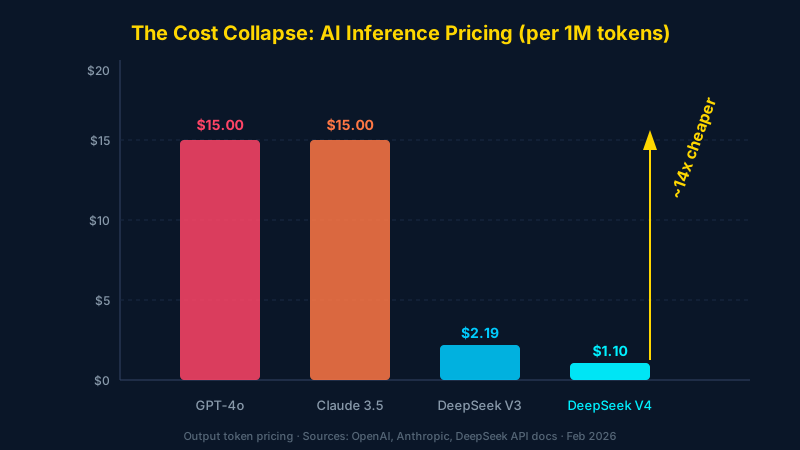
And the model is open-weight, released under Apache 2.0. Anyone can download it. Anyone can run it. The internal benchmarks claim 80%+ on SWE-bench (a notoriously difficult software engineering benchmark) and 98% on HumanEval. If these numbers hold under independent evaluation — and early third-party testing suggests they largely do — then the idea that you need a $100 billion hyperscaler to produce world-class AI is simply, empirically, wrong.
II. Alibaba’s Qwen 3.5 and the Chinese New Year Offensive
DeepSeek did not act alone. On February 16 — the eve of the Lunar New Year — Alibaba Cloud released Qwen 3.5, a model explicitly designed for what the industry now calls the “agentic AI era.” The flagship open-weight version runs 397 billion parameters, with only 17 billion active at any given time (another Mixture-of-Experts design, following the efficiency-first playbook that Chinese labs have made their signature).
Qwen 3.5 is natively multimodal: text, images, and video processed within a single architecture, not bolted together as afterthoughts. It is optimised for agentic workflows — AI systems that can independently plan, execute, and verify multi-step tasks. Alibaba specifically highlighted compatibility with open-source agent frameworks, including OpenClaw, which has seen a surge in adoption among developers building autonomous AI pipelines.
ByteDance’s Doubao 2.0 launched the same weekend. So did upgraded models from Zhipu AI. The timing was not coincidental. Chinese AI labs have turned the Lunar New Year into a tradition of competitive release — a kind of technological fireworks display, each company trying to upstage the others before the holiday break.
Marc Einstein, research director at Counterpoint Research, told CNBC the pattern reflects an industry preparing for AI agents to “upend traditional Internet business models.” The companies see the same future: intelligence will not live in a cloud API you rent. It will live on your device, in your infrastructure, under your control. And the race to make that future real is now a sprint.
III. Mars, Autonomy, and the End of Remote Control
While the model wars raged on Earth, something quieter and arguably more significant happened 225 million kilometres away.
On December 8 and 10, 2025 — announced by NASA’s Jet Propulsion Laboratory in late January 2026 — the Perseverance rover completed its first drives on Mars planned entirely by artificial intelligence. No human rover planners in the loop. A vision-capable generative AI analysed high-resolution orbital imagery from the HiRISE camera aboard the Mars Reconnaissance Orbiter, identified terrain features (bedrock, boulder fields, sand ripples), and generated a continuous path complete with waypoints.
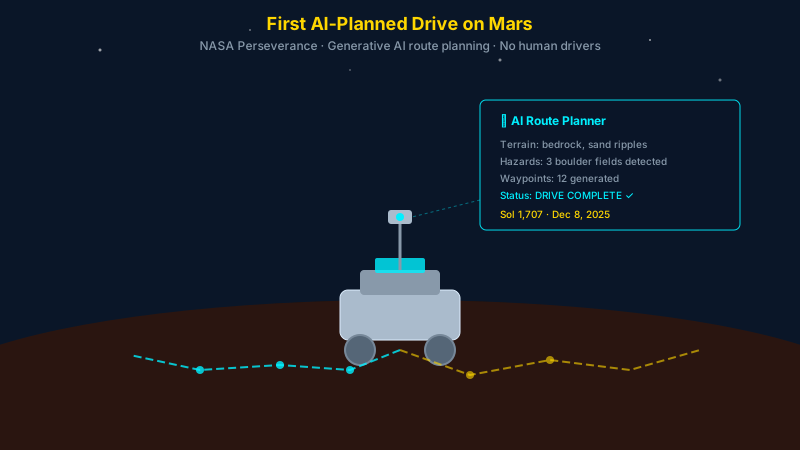
For 28 years, across multiple missions, every metre a rover drove on Mars was planned by human operators on Earth. They would analyse terrain data, sketch routes using waypoints spaced no more than 100 metres apart to avoid hazards, then transmit the instructions via NASA’s Deep Space Network. The communication lag — anywhere from 4 to 24 minutes one way — made real-time “joysticking” impossible. Human planning was not a preference. It was a constraint.
That constraint is now optional.
NASA Administrator Jared Isaacman called it “a strong example of teams applying new technology carefully and responsibly in real operations.” But the implications extend far beyond Mars. If AI can autonomously navigate an alien planet using orbital photography, the argument that AI requires constant human oversight in terrestrial applications becomes harder to sustain. The Perseverance demonstration is a proof of concept not just for space exploration, but for autonomous systems everywhere — from self-driving vehicles to industrial robotics to, yes, decentralised computing networks that must make decisions without phoning home to a central server.
IV. The Decentralisation Thesis, Vindicated
Here is the connection that most commentary misses: the cost collapse of frontier AI is the decentralisation story.
For years, the prevailing wisdom held that AI would centralise power. Training frontier models required billions of dollars, thousands of GPUs, and the kind of infrastructure only a handful of companies could afford. The future, in this telling, belonged to OpenAI, Google, Anthropic, and perhaps a few others — cloud landlords renting intelligence by the token, extracting value from every interaction, accumulating data and leverage with each passing quarter.
February 2026 demolished that thesis.
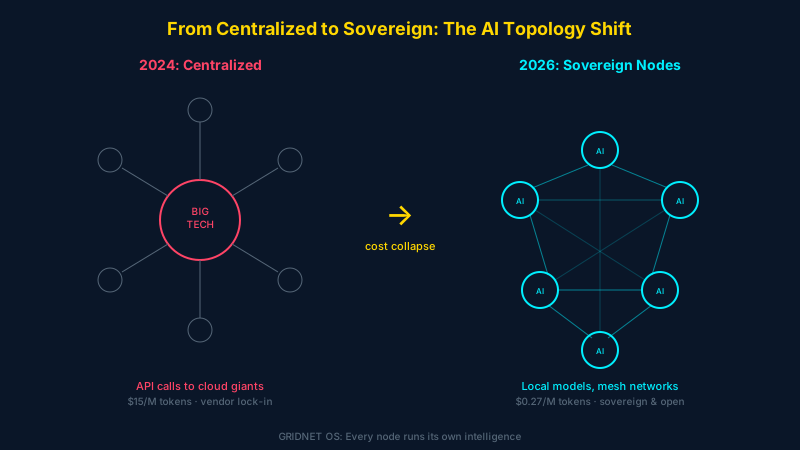
When a Chinese lab ships a GPT-4-class model at one-tenth the cost, under an Apache 2.0 licence, running on dual RTX 4090s — consumer-grade hardware — the monopoly thesis does not merely weaken. It evaporates. The economic moat that was supposed to protect Western hyperscalers turns out to have been a temporary condition of early-stage technology, not a permanent feature of AI economics.
This is precisely the future that GRIDNET OS was designed for. The vision of sovereign, locally-run AI nodes — intelligence that lives on your hardware, answers to your rules, and participates in a decentralised mesh rather than reporting to a corporate cloud — was always predicated on one assumption: that the cost of running frontier AI would eventually fall to the point where centralisation became a choice rather than a necessity.
“Eventually” arrived in February 2026.
Consider what $0.27 per million input tokens actually means in practice. A small business can run its own AI infrastructure. A journalist can process an entire leaked document archive without sending it to a third-party API. A hospital can run diagnostic AI on local servers, keeping patient data within its own walls. A nation can deploy AI systems without depending on — or being subject to the terms of service of — an American or Chinese technology company.
Sovereignty, in the age of AI, is no longer a luxury. It is economically viable. And with open-weight models, it is technically straightforward.
V. The Regulatory Shadow
But here is where the story darkens.
The EU AI Act becomes fully applicable on August 2, 2026 — less than six months away. While the Act includes reduced requirements for open-source models, it imposes transparency obligations and additional evaluations for “high-capability” models that could, depending on interpretation, sweep in precisely the kind of open-weight frontier systems that DeepSeek and Alibaba are now shipping to the world.
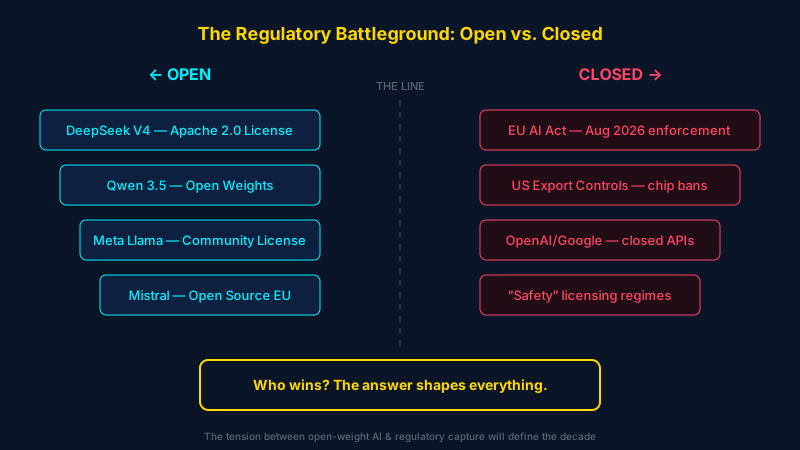
The United States, meanwhile, continues to tighten chip export controls — the same controls that, paradoxically, may have forced Chinese labs to develop the efficiency-first architectures that are now undercutting Western pricing. And behind closed doors, lobbying efforts by incumbent AI companies push for licensing regimes that would effectively require government permission to train or distribute large models.
The pattern is familiar from every previous technological disruption. The incumbent powers, unable to compete on cost or openness, turn to regulation as a competitive weapon. The language is always safety. The effect is always centralisation.
This is not to say that AI safety concerns are illegitimate — they manifestly are not. Models capable of generating bioweapon synthesis routes or automating cyberattacks pose real dangers that demand thoughtful governance. But there is a vast difference between targeted regulation of genuinely dangerous capabilities and broad licensing regimes that happen to raise barriers to entry for competitors while entrenching incumbents.
The question that will define the next decade of AI is not whether these models will be powerful. That is already settled. The question is: who gets to run them?
If open-weight models remain open — if Apache 2.0 licences are honoured, if regulatory frameworks distinguish between dangerous applications and the models themselves — then February 2026 marks the beginning of genuine AI democratisation. Intelligence becomes infrastructure, like electricity or the internet: widely available, locally controllable, subject to the laws of the jurisdiction where it operates rather than the terms of service of a Silicon Valley corporation.
If, on the other hand, regulatory capture succeeds — if licensing regimes restrict who can train, distribute, or run large models — then the cost collapse will have been a brief window of openness, a tantalising glimpse of a decentralised future that was closed before it could fully materialise.
VI. The Accelerando
The science fiction writer Charles Stross coined the term “accelerando” to describe the period of rapidly increasing technological change leading up to a singularity — the point at which the pace of innovation exceeds the ability of human institutions to track, regulate, or even comprehend it.
We are not at the singularity. But the accelerando has, by any reasonable measure, begun.
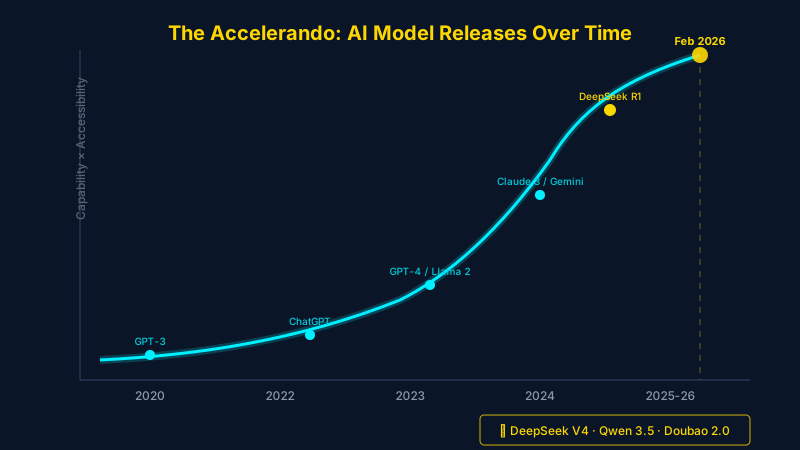
Consider the trajectory. In 2020, GPT-3 astonished the world with coherent text generation. By 2023, GPT-4 could reason about images, write code, and pass professional exams. By early 2025, DeepSeek R1 proved that frontier reasoning did not require frontier budgets. And now, in February 2026, we have trillion-parameter models with million-token context windows, shipping at pennies per query, under open licences, while an AI drives itself across Mars.
The gaps between these milestones are not constant. They are shrinking. Each generation arrives faster, costs less, and does more than the last. This is not linear progress. This is exponential progress that has reached the part of the curve where the human eye can finally see it bending upward.
What happens next depends on choices that are being made right now — in Brussels, in Washington, in Beijing, in open-source communities, in corporate boardrooms. The technology is no longer the bottleneck. The bottleneck is governance, economics, and will.
For those building decentralised systems — sovereign AI nodes, mesh computing networks, open protocols that treat intelligence as a shared resource rather than a proprietary service — February 2026 is a vindication and a warning. The tools are here. The economics work. The window is open.
But windows close.
The accelerando has begun. The only question is whether it will be open or enclosed — whether the exponential curve of AI bends toward liberation or toward a new and more sophisticated form of control.
The answer is being written now. And for the first time, the pen is not held by a single hand.
References & Sources
- Altman, S., “The Intelligence Age,” OpenAI, September 2025. [OpenAI]
- Pichai, S., “I/O 2025 Keynote,” Google Official Blog, 2025. [Google Blog]
- Huang, J., GTC 2025 Keynote Address, NVIDIA Corporation, March 2025. [NVIDIA]
- Nadella, S., Microsoft Build 2025 Keynote, Microsoft Corporation. [Microsoft]
- Vinge, V., “The Coming Technological Singularity: How to Survive in the Post-Human Era,” Whole Earth Review, 1993. [SDSU Archive]
- Kurzweil, R., The Singularity Is Nearer: When We Merge with AI, Viking / Penguin Random House, 2024. [Penguin Random House]
- Reuters, “AI industry leaders outline competing visions for artificial intelligence,” 2025. [Reuters Technology]
- Associated Press, “Tech giants race to define AI’s future amid safety concerns,” 2025. [AP News]