

A team at UC San Diego has built a CRISPR system that spreads through bacterial colonies and deletes antibiotic resistance genes. It is, in every meaningful sense, a gene drive for bacteria — self-propagating biological code. The implications reach far beyond medicine. They reach into the deepest questions of power, control, and who gets to write the software that rewrites life.
The Superbug Clock Is Ticking
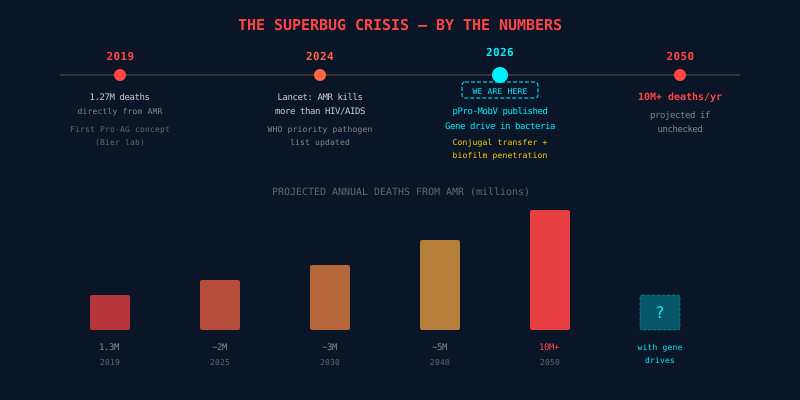
In 2019, antimicrobial resistance (AMR) killed 1.27 million people directly — more than HIV/AIDS, more than malaria. By 2050, projections from the Lancet and the World Health Organization place that number above ten million deaths per year. To put it plainly: we are running out of antibiotics, and the bacteria know it.
The mechanics are grimly elegant. Bacteria share resistance genes on plasmids — small, circular DNA molecules that replicate inside cells and pass between organisms like gossip in a crowded room. One bacterium develops resistance; within hours, entire colonies carry it. Hospitals, fish farms, sewage treatment plants, livestock operations — these are the breeding grounds of superbugs, and conventional antibiotics are losing the arms race.
For decades, the medical establishment’s strategy has been to develop new antibiotics faster than bacteria develop resistance. That strategy has failed. The pipeline of new drugs has slowed to a trickle, while resistance has accelerated. We need a fundamentally different approach.
In February 2026, we may have gotten one.
Enter pPro-MobV: The Gene Drive That Hunts Resistance
In early February 2026, researchers from the laboratories of Professors Ethan Bier and Justin Meyer at the UC San Diego School of Biological Sciences published a paper in npj Antimicrobials and Resistance (a Nature journal) describing a system called pPro-MobV — a second-generation Pro-Active Genetics (Pro-AG) tool that does something no previous technology could reliably do: spread through bacterial populations and systematically disable antibiotic resistance genes.
The concept builds on gene drive technology, which has been used in insects to suppress malaria-carrying mosquitoes. But translating gene drives to bacteria required solving a different problem. Insects reproduce sexually, providing a natural mechanism for gene drives to spread. Bacteria don’t mate — at least not in the traditional sense.
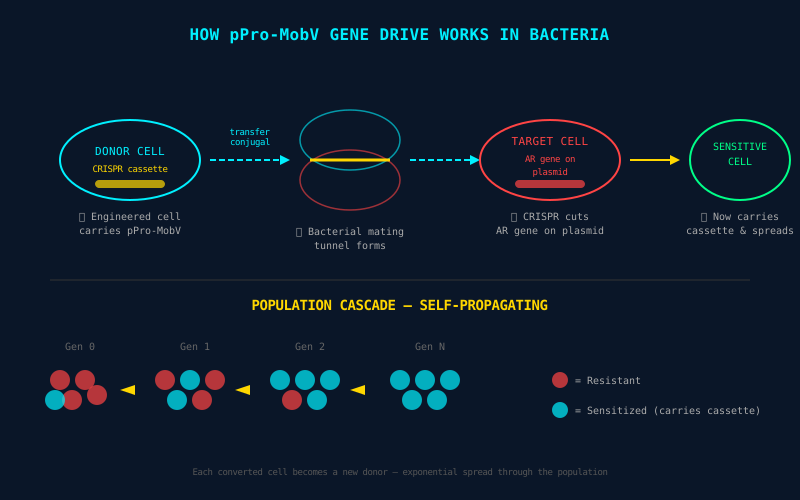
Except they do, in a way. Bacteria perform conjugal transfer — they build tiny tunnels (called pili) between cells and pass genetic material through them. Bier’s team engineered pPro-MobV to exploit this natural mating infrastructure. The system introduces a CRISPR cassette that:
- Enters a target bacterium via conjugal transfer through the mating tunnel
- Locates resistance genes on the target cell’s plasmids
- Cuts and inactivates those resistance genes using CRISPR
- Copies itself into the target — turning every converted cell into a new donor
The result is exponential propagation. A “few cells,” as Bier put it, can be released into a population and left to “neutralize AR in a large target population.” Each infected bacterium becomes a vector for the cure.
“With pPro-MobV we have brought gene-drive thinking from insects to bacteria as a population engineering tool. With this new CRISPR-based technology we can take a few cells and let them go to neutralize AR in a large target population.”
— Professor Ethan Bier, UC San Diego
Breaking Through Biofilms

Perhaps the most striking finding is that pPro-MobV works inside biofilms — the dense, surface-clinging communities of bacteria that are responsible for the majority of serious infections. Biofilms are antibiotics’ worst nightmare. They form a protective layer that drugs struggle to penetrate, and they serve as reservoirs for resistance genes.
“The biofilm context for combatting antibiotic resistance is particularly important since this is one of the most challenging forms of bacterial growth to overcome in the clinic or in enclosed environments such as aquafarm ponds and sewage treatment plants,” Bier explained.
The researchers also showed that components of the system can be carried by bacteriophages — viruses that naturally infect bacteria. This opens a second delivery mechanism: instead of relying solely on conjugal transfer, future iterations could use phage as precision delivery vehicles, targeting specific bacterial species with CRISPR payloads.

Bier estimates that roughly half of antibiotic resistance in humans originates from environmental sources — animals, aquaculture, sewage. If pPro-MobV or its successors could be deployed in these environmental reservoirs, the impact on the global resistance crisis could be transformative.
Self-Rewriting Code — The Uncomfortable Analogy
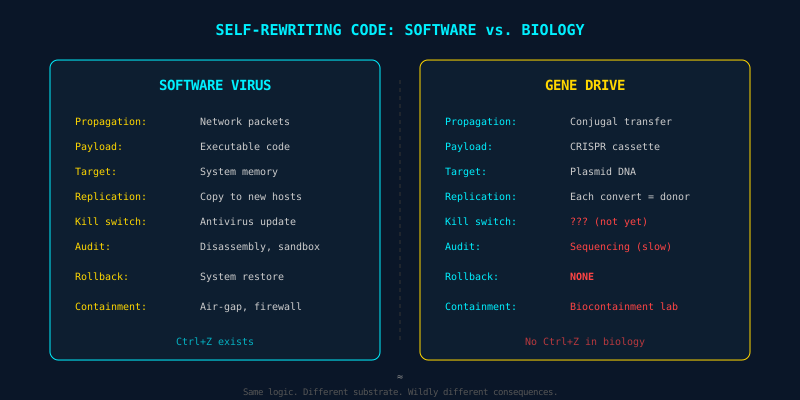
Now let’s talk about what this actually is.
Strip away the biochemistry, and pPro-MobV is self-propagating code that rewrites other code. It enters a host. It locates specific sequences. It edits them. It copies itself. It spreads. Every target it reaches becomes a new vector.
In computer science, we have a word for this: a worm.
The analogy isn’t metaphorical — it’s structural. A gene drive cassette and a computer worm share the same fundamental architecture: autonomous propagation, payload delivery, self-replication, and exponential spread through a network of hosts. The substrate is different (DNA instead of silicon), but the logic is identical.
And here’s where it gets uncomfortable: in software, we have rollback. We have firewalls, air-gapping, antivirus updates, sandboxed environments. We can disassemble malware, study it, and neutralize it.
In biology, there is no Ctrl+Z.
Once a gene drive is released into an open ecosystem, it propagates. It mutates. It interacts with other organisms in ways we cannot fully predict. Containment, once breached, is functionally irreversible. This is not a software deployment you can roll back with a hotfix. This is a permanent edit to the living world.
Which brings us to the question that matters most — not can we build this, but who controls it?
The Biopower Question
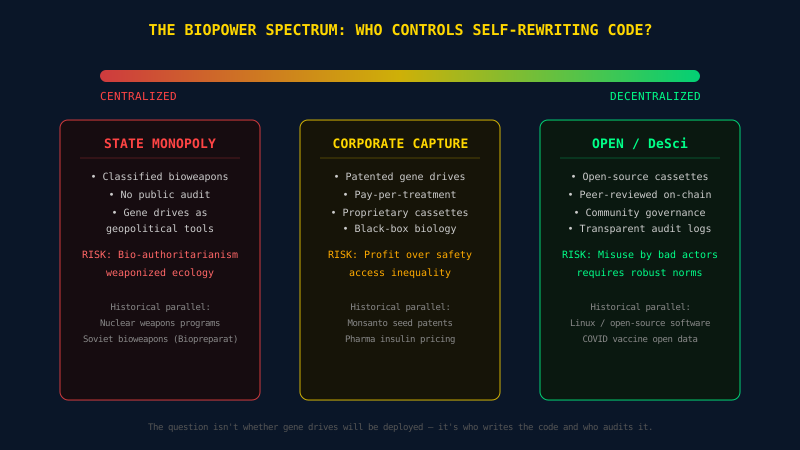
The philosopher Michel Foucault coined the term biopower to describe the ways states exercise control over biological life — through public health mandates, population management, and the regulation of bodies. Gene drives represent a new frontier of biopower that Foucault could barely have imagined: the ability to rewrite the genetic code of entire species populations.
Consider the scenarios:
Scenario 1: State monopoly. Governments classify gene drive technology as dual-use and restrict it under biosecurity regulations. Research becomes classified. Deployment decisions are made by defense ministries and intelligence agencies. The public has no visibility into what gene drives are being developed, tested, or released. This is the nuclear weapons model applied to biology — and it carries the same risks of secret programs, arms races, and catastrophic miscalculation. The Soviet Union’s Biopreparat program — a massive, secret biological weapons effort that wasn’t fully disclosed until defectors revealed it — is the cautionary tale.
Scenario 2: Corporate capture. Pharmaceutical companies patent gene drive cassettes. Treatment becomes a product. Access is determined by market dynamics — meaning wealthy nations get protection while the Global South, where antibiotic resistance hits hardest, is left behind. The cassette designs are proprietary, meaning independent researchers cannot audit them for safety or off-target effects. This is the Monsanto seed patent model applied to microbiology.
Scenario 3: Open science. Gene drive designs are published openly. The research is peer-reviewed and reproducible. Deployment protocols are governed by community consensus. Safety testing is transparent and auditable. This is the model that UC San Diego’s publication in an open-access journal already points toward — but it requires infrastructure to sustain it.
The third scenario is the only one that doesn’t end in a dystopia. But open science doesn’t maintain itself. It requires infrastructure that is resistant to censorship, capture, and coercion.
DeSci and the Case for Decentralized Biosecurity
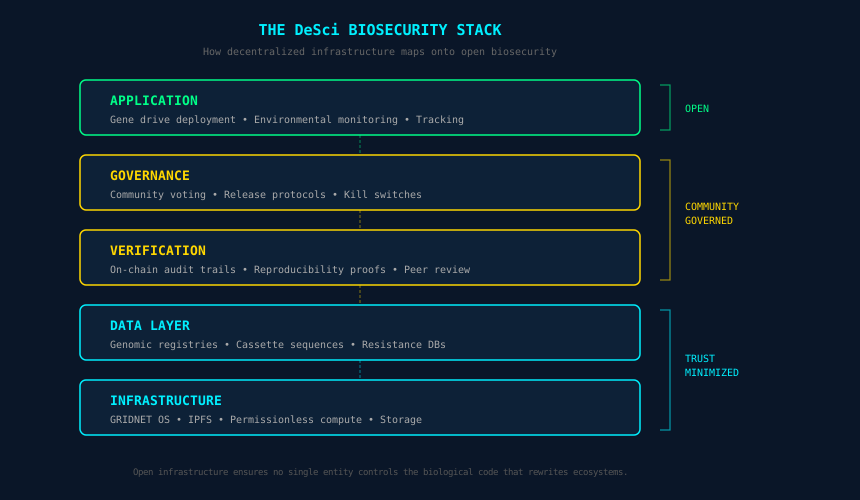
This is where decentralized science (DeSci) stops being an abstract blockchain talking point and starts being an urgent necessity.
The problem with centralized control of gene drives isn’t just philosophical — it’s practical. Centralized systems have single points of failure. A government can classify research. A corporation can bury inconvenient safety data. A journal can retract a paper under political pressure. A regulatory agency can be captured by the industry it’s supposed to regulate.
Decentralized infrastructure addresses these failure modes directly:
- Censorship-resistant storage ensures that published gene drive sequences and safety data cannot be taken down by any single actor. Once research is published to a decentralized network, it stays published.
- Permissionless compute means that independent researchers anywhere in the world can run simulations, verify results, and test cassette designs without needing approval from institutions that might have conflicts of interest.
- On-chain audit trails provide immutable records of who published what, when, and what modifications were made — creating transparency that traditional journals and regulatory filings cannot match.
- Community governance through decentralized autonomous organizations (DAOs) allows stakeholders — researchers, ethicists, affected communities — to participate in deployment decisions, rather than leaving them to governments or corporate boards.
This is not theoretical. GRIDNET OS, for example, provides exactly this kind of permissionless, censorship-resistant infrastructure — a decentralized operating system where computation and storage cannot be shut down by any single authority. The same architecture that protects decentralized finance and uncensorable communication can protect the open science that biosecurity demands.
The parallel to software security is instructive. The cybersecurity community learned decades ago that security through obscurity fails. The systems that survive are the ones that are open, audited, and stress-tested by adversaries. Linux didn’t become the backbone of the internet by being proprietary — it became secure because it was open. The same logic applies to biosecurity: gene drive designs that are locked in corporate vaults or government classified programs are less safe than designs that are open to the global research community for scrutiny.
The Code That Writes Itself
There’s a deeper philosophical dimension here that deserves attention.
For most of human history, our tools have been inert. A hammer doesn’t replicate. A drug molecule doesn’t spread from patient to patient. Even a nuclear weapon, for all its destructive power, sits still until someone detonates it.
Gene drives are different. They are tools that act autonomously. Once deployed, they propagate without further human intervention. They make copies of themselves. They modify organisms they encounter. They spread through populations according to their own logic — not ours.
In the language of software: they are agents.
We are entering an era where both digital and biological systems exhibit autonomous agency — AI models that generate their own training data, gene drives that rewrite populations without further instruction. The governance challenge is the same in both domains: how do you maintain meaningful human oversight over systems designed to operate independently?
The answer, in both cases, is the same: transparency, auditability, and distributed control. No single entity should have unilateral power over autonomous systems — whether those systems run on silicon or DNA. The infrastructure of oversight must be as resilient and distributed as the systems it oversees.
What Comes Next
pPro-MobV is a laboratory proof of concept. It has been demonstrated in E. coli biofilms under controlled conditions. The road to real-world deployment — in hospital wastewater systems, aquaculture ponds, or clinical applications — is long and uncertain. Regulatory frameworks for environmental release of gene drive organisms don’t yet exist in most jurisdictions. The ecological interactions of released gene drives in complex microbial communities are poorly understood.
But the science is now undeniable. The mechanism works. Conjugal transfer can be hijacked to spread CRISPR cassettes. Antibiotic resistance genes can be deleted from bacterial populations at scale. Biofilms can be penetrated. Phage delivery adds a second vector. The toolbox is expanding rapidly.
The question is no longer whether self-rewriting biological code will be deployed in the real world. The question is whether the infrastructure of oversight — the auditing, the governance, the transparency — will be in place when it happens.
If that infrastructure is centralized, it will be controlled by the few, for the few. If it is decentralized — permissionless, censorship-resistant, community-governed — it has a chance of serving everyone.
The bacteria are already sharing code. The question is whether we will, too.
Paper reference: Kaduwal, S. et al. “A conjugal gene drive-like system efficiently suppresses antibiotic resistance in a bacterial population.” npj Antimicrobials and Resistance (2026). doi:10.1038/s44259-026-00181-z
References & Sources
- Valderrama, J.A. et al., “CRISPR-based gene drives in bacteria,” Nature Biotechnology, February 2026. [Nature Biotechnology]
- Hammond, A. et al., “A CRISPR-Cas9 gene drive system targeting female reproduction in the malaria mosquito vector Anopheles gambiae,” Nature Biotechnology, 34, 78–83, 2016. [Nature Biotechnology]
- Esvelt, K.M. et al., “Concerning RNA-guided gene drives for the alteration of wild populations,” eLife, 3:e03401, 2014. [eLife]
- World Health Organization, “Antimicrobial Resistance — Global Report on Surveillance,” WHO, 2024. [WHO]
- National Academies of Sciences, Engineering, and Medicine, Gene Drives on the Horizon: Advancing Science, Navigating Uncertainty, and Aligning Research with Public Values, The National Academies Press, 2016. [National Academies Press]
- Reuters, “Scientists develop first bacterial gene drive using CRISPR,” February 2026. [Reuters]