

Dear followers of GRIDNET-OS, let us Rejoice!😊 For there are more reasons to fest than ever before!🥳
The Project had been established in the early 2017.Now that’s quite some time. Ever since we have been implementing a plethora of algorithms and functionalities – only a small fraction of which has been put into use so far. As some of you say, you’re simply not ready to be playing with some of the spells as of yet😆 Indeed. Only a small fraction of the target possibilities is tangible at the very current moment. And it does show off anyway! Recently we have opened up significantly with the release of the public Test-Net and even further by making the mobile app available for both the Google’s and Apple’s mobile computational platforms!
As you shall come to see, things are to be moving rapidly from now on. It’s worth to follow, it’s worth to subscribe and let yourself be heard as all of your opinions help is improve upon what there already is and making the final product more enjoyable to use. In the end it’s all about you! We know that and we deliver.
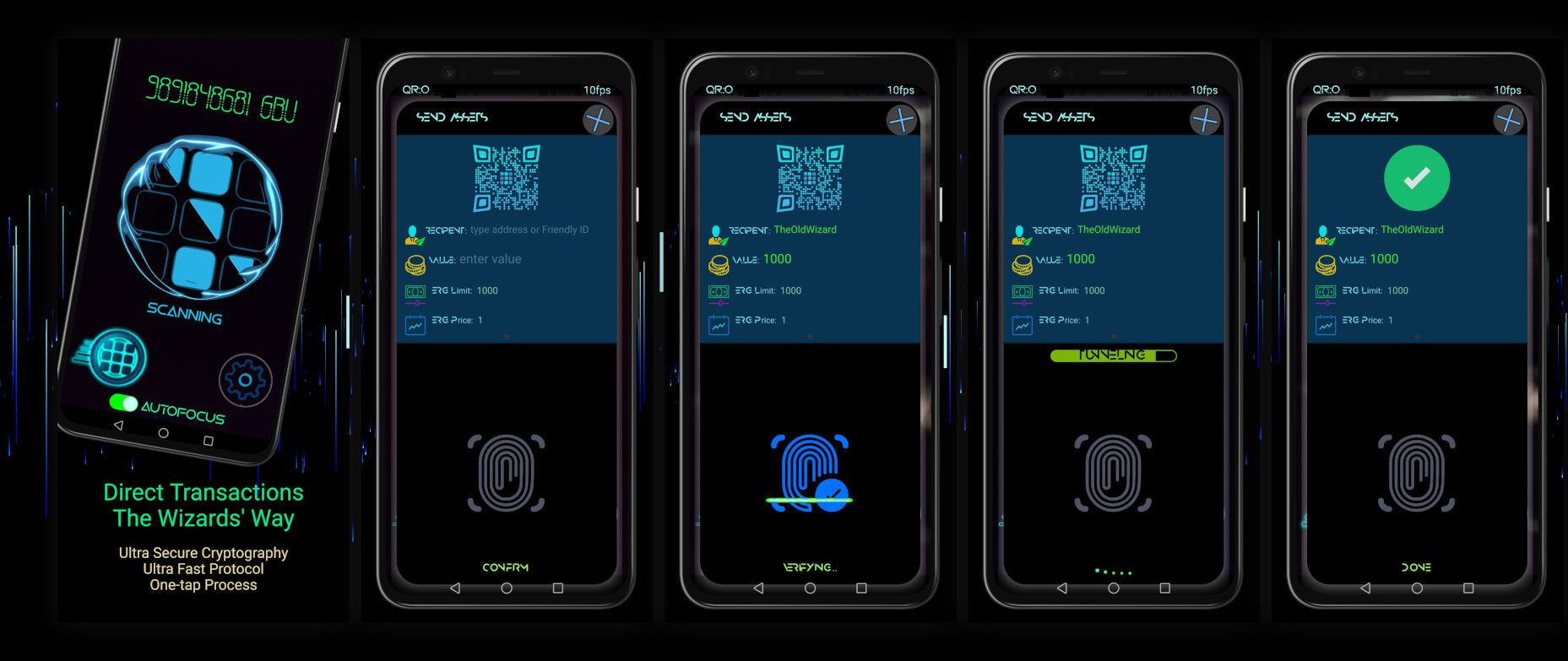
Looking crazy cool.. doesn’t it…
Test-Net? Not quite so. The accounts’ balances are guaranteed to persist and make it through to ‘Live-Net’, meaning the state of network which is to comprise the main-network and not the one established for testing-purposes. That is invariant to whether the Test-Net officially transitions into a ‘Live-Net’ or whether the history of events shall be started anew. The rewards you get – they are to stay!😁
Under these assumptions, even now, GRIDNET Coin as a full-fledged currency, the tokenomics of which are currently not confirmed i.e. made public. One they are they will be immutable i.e. set in stone till the end of time.You must understand. The numbers have been of least interest to Wizards🧙🧙♀️ (except for prime numbers of course!) ever since the Project’s conception. Technology is what they have been after. To seek, to research and to provide all of us with new possibilities. Ones at astonishing quality in terms of security, ease of use, functionality.. and also anonymity. Nevertheless, parameters of the internal economy are extremely important. Were Wizards🧙🧙♀️ careful enough to consider this as the icing on the cake ? The last thing to be taken care of?Whatever the reason, The Tokonomics are scheduled to be published in days to follow.
What’s Further
By reading on despite showcasing how to issue transactions from the mobile app we’ll introduce you to the important concepts of:
- GRDINET Coins (GNC)
- GRIDNET Basic Units (GBU)
- ERG
- ERG Limit
- ERG Price
Technology, Economics and a drop of the Wizards‘🧙🧙♀️ philosophy
We have been creating the very first 100% decentralized, multipurpose operating system ~nothing less~. One which resembles one which you know from the Windows/Linux or Mac OS realms. But why create such a thing in the first place? Why not let us stick co centralized servers who will always be more performant in orders of magnitude? The reason is – freedom. We want platforms from you you are not banned on day B just because an administrator or a CEO of a company wishes you so. The modern history already shown us that you may be the so called ‘world leader in day A’ and suddenly be marketed on grounds similar to terrorist on day B just if media (even those major ones broadcast from satellites) are paid well enough. We want actual freedom. We want anonymity. Of course we also want safety for all of us. If someone is considered as a threat to a society we will be introducing global consensus algorithms and let the people decide! Not the CEOs and other media manipulators.
When it comes to the economical properties, these are equally as important to investors as to everyday users who need to trust in their properties. People need to know that the parameters are fair, that these are not subject to change and lead to a healthy economy.
On the other hand, technology does change. It needs to change. It needs to improve. We accept that. Bitcoin does not.
Progress
That’s what drives our species towards a better day. Even though we’ve all seen at least a couple of Black Mirror episodes on Netflix😆. To let the truth be said – only we can help ourselves. There’s nobody else as far as current practice is observed. In the past people used to ascribe draughts, floods, or catching the plague to the wishes of ‘God’ and blamed themselves for wrongdoings. Today we resort to scientists. Such thought cross our minds no more – and that’s progress.
It’s perfectly fine to admit that we know nothing in the Grand sense of things. There’s nothing wrong with that. Dogs and cats around us tend to be ‘happy’. They on the other hand have real ‘gods’ around.🦸
Alas, enough of philosophy, ~ technology at the table!🤖
Before we dive deep into to recent changes it’s worth to mention that recently, after Microsoft finally decided to integrate Linux into their ‘operating system’ we can join GRIDNET OS simply by invoking
‘ssh -o StrictHostKeyChecking=no test.gridnet.org’ from the command line. The ‘Putty’ SSH client is needed no more.
or straight from the Windows’ Run utility:

Connecting from the Windows ‘run’ utility
or by pasting the command directly to the field at the bottom of your screen as seen below:

ssh command straight within the bottom search bar
The “-o StrictHostKeyChecking=no” part instructs the SSH Client to ommit public-key verifications. Usually that protects against connecting to malicious nodes, but here
- the public key of a GRIDNET OS full-node keeps changing
- there will be many full-nodes you will be connected to a random one
- GRIDNET OS employs authentication mechanics of its own through the mobile app and full-node is assumed as non-trusted at all times, anyway. It can take from you or get to know about you nothing.
ℹ You may use GRIDNET OS from your friend’s computer, or at the airport. Sensitive data never leaves the mobile app.
Making Transactions From the Mobile App
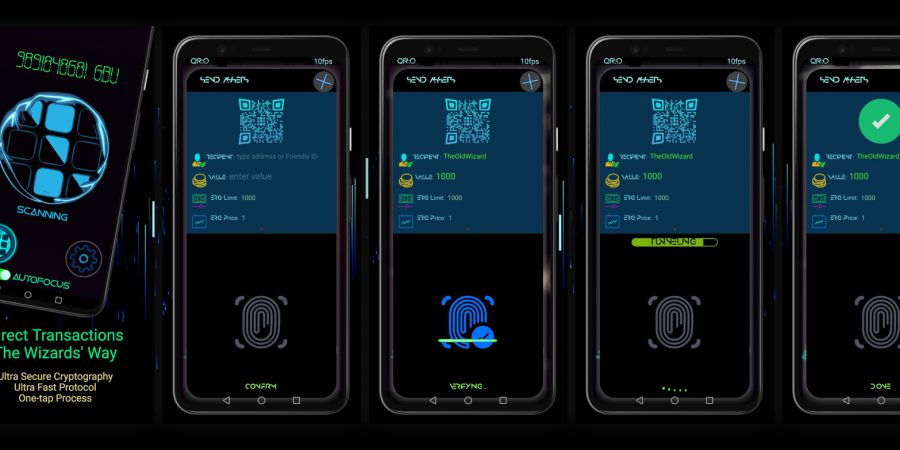
Now to the main topic! We have added support of direct transactions directly from the mobile app! That is right. From now on the mobile app functions as a full-fledged wallet. Along with other functionalities this probably renders it the most high-tech utility of such a kind one may get by.
Yesterday, the update had been verified by both Google and Apple who let it through to the Google’s Play Store and Apple’s App Store respectively. We always choose to provide both companies with Debug Symbols (it’s optional) so that they can lurk into everything should they choose to do so😇. There’s nothing to hide and the source code will be available soon enough, anyway.
Let us now take a closer look on how to issue issue a transaction, enough talking! 😆
- See the button in the left-bottom corner? It’s the Transaction Button. As soon as you’ve got your wallet all set-up it starts flashing, actually looking pretty cool 😍.
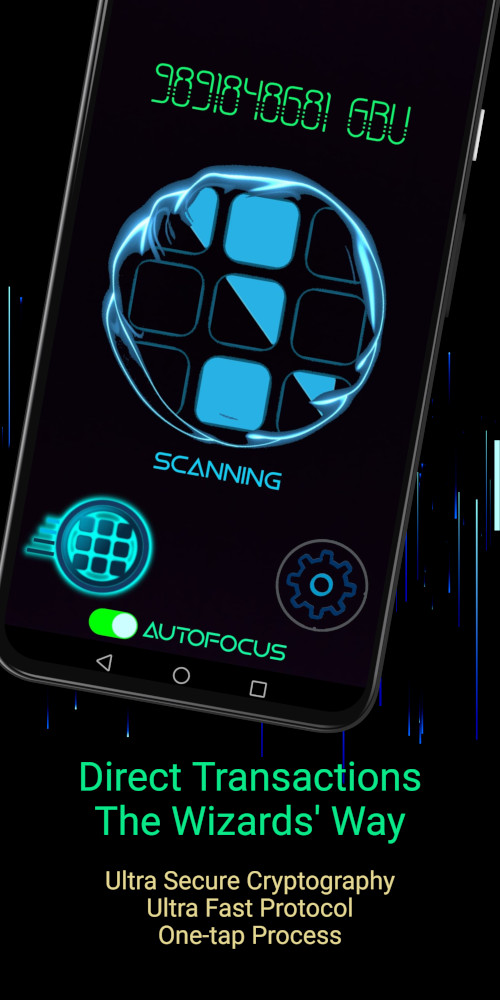
(..) and it’s here, finally !
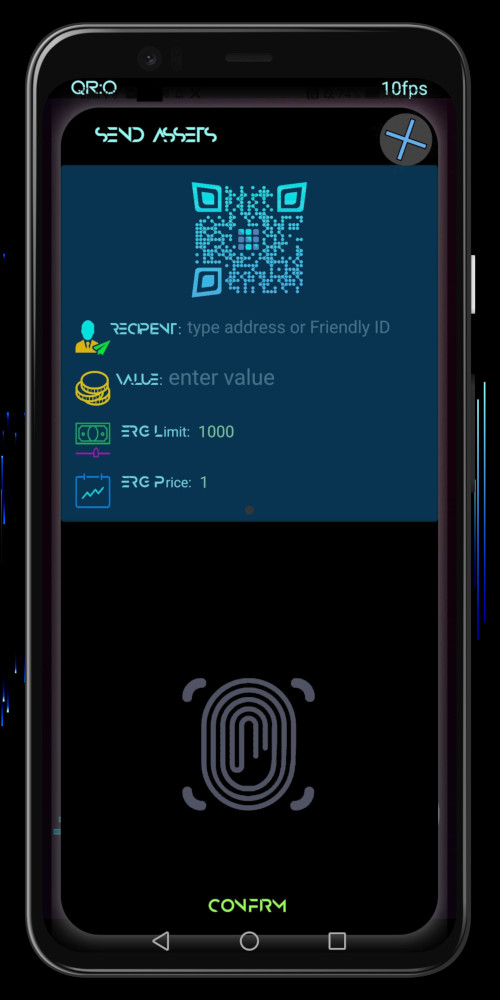
Some data needs to be filled in.
Tap on it to see the Transaction View. You’ll be using this view to provide transaction’s details.
The fields are self-explanatory. Literally. When there’s no value set, the fields would provide you with some explanation automatically.
Let us go over these here one be one.
- The Recipient’s Field – here you may enter either the recipient’s full address – which is a value generated based on a public key. One typically gets his address by switching to the Setting’s View and clicking the Copy Button located next to the Address field. The recipient might have provided you with his Friendly ID, which might look like ‘TheOldWizard’ and would be thus much easier to remember. You may see how to generate an Identity Token of your own over here.
- Value – that’s the value in GRIDNET Basic Units. You may think of these as counterparts of ‘satoshis’ from the Bitcoin realm. Many GBUs comprise a single GRIDNET Coin (how many? we do not know yet! but is this important? It’s just a naming convention). The value reported on the Home Screen is in GRIDNET Basic Units (GBUs).
- ERG Limit – you may think of it as the Ethereum’s Gas-Limit counterpart. Here you specify the upper limit of fees you’re ready to spend on this very transaction. You may leave the defaults. Any full-node would charge you the exact same amount of ERG for the same transaction as ERG cost is associated with particular #GridScript instructions and these are constant values. Each ‘transaction’ is comprised of multiple #GridScript commands.
- ERG Price – that’s a bid for one unit of ERG that you are willing to make. The minimum bid accepted might differ across full-nodes and is driven entirely by forces of supply and demand. The lower value (min. is 1) the better for you as you’re spending less on your transaction. The higher value – the higher income for miners i.e. the higher priority for them to process the transaction.
Let us stay here for a moment. Why decouple the price of ERG from GBU/GNC? Why yet another system-intrinsic ‘currency’? That allows to detach the effects of economy from feasibility of operations on the GRIDNET’s decentralised state-machine. Even if the price of GNC skyrockets, or dwindled the full-nodes will be able to leverage the costs of operations at a very affordable level or remain profitable.
Various operations on the decentralized state-machine impose varying overheads on both of the full-nodes’ Central Processing Units and storage facilities. To address these differences, low level #GridScript instructions have constant ERG-costs associated. For example, assigning value to a variable located within volatile memory accessible only during program’s execution would have much lower ERG costs than storing data within the GRIDNET’s Eternal Storage.
Let us now fill-in all of the details and proceed😀.
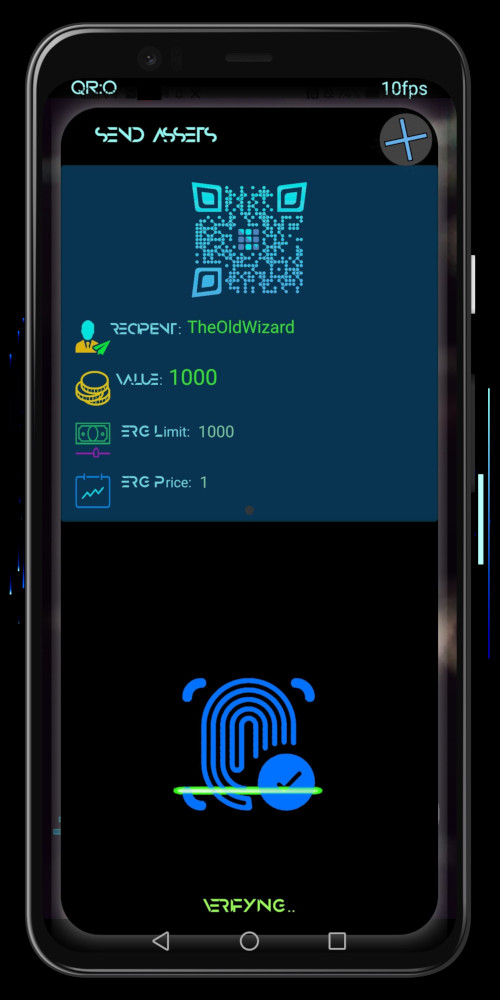
Never enough of security!
As seemingly above all the details have been provided, all it takes now is to let the Virtual Fingerprint sensor do its work. Touch it for a couple of seconds, let the laser pass your finger once or twice. And in a moment…TADAM! 😁
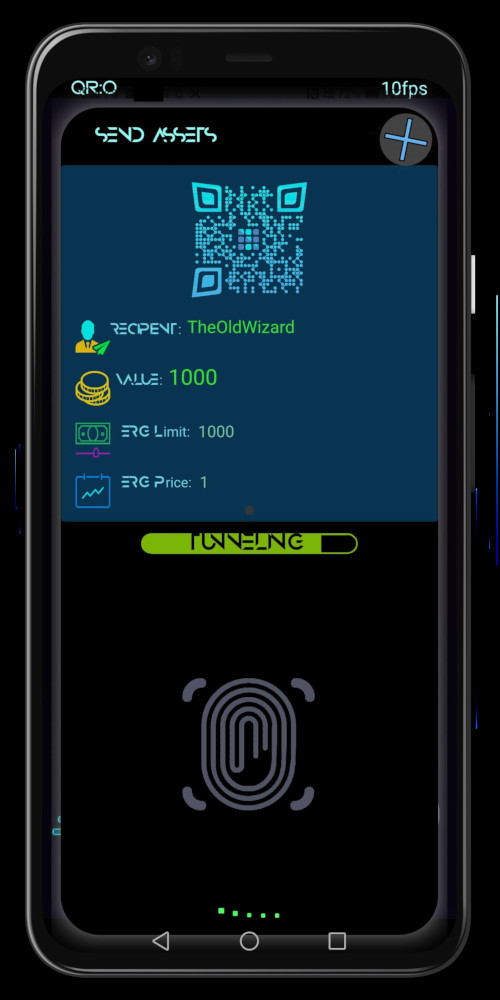
Hueston? We’re tunneling in 3…2…1
What a joy! The Magic begins to happen! What a joy!🤩 But.. what is actually going on over here? There are a couple of interesting points to note.
Technical Details (sort of)
Each GRIDNET Token is constantly connected to the network. Worry not by default it sends beacons every minute or so and only to update you account’s balance so the batterie’s life-time should not be affected at all. The protocol employed under the hood is UDT. Citing its authors :
UDT is a reliable UDP based application level data transport protocol for distributed data-intensive applications over wide area high-speed networks. UDT uses UDP to transfer bulk data with its own reliability control and congestion control mechanisms. The new protocol can transfer data at a much higher speed than TCP does. UDT is also a highly configurable framework that can accommodate various congestion control algorithms.
In short, UDT is a protocol used in High-Throughput data-centers and now it’s available straight from your mobile device! The mechanics improved upon by Wizards🧙🧙♀️ allow for NAT and Firewall traversals, meaning you’ll be able to issue transactions in any situation. It’s rigid.
Now let us dive deeper into even more interesting things.
We’ve mentioned that the GRIDNET Token app maintains constant connectivity with the network. What doe sit mean? Let’s think what happens when you connect to the GRIDNET OS over SSH. When you do, a unique copy of a GRIDNET VM is spawned to you in sandbox mode (as discussed in other tutorials). Then you may continue issuing commands, instructions or even playing in-terminal multiplayer games (check out Snake🐍). Once you are connected over SSH you may either commit or quit. The full-node serving you the VM takes care of everything. Similar thing happens when the moble app connect. The your mobile device maintains a persistent connection with a an instance of GRIDNET VM spawned specifically for it. When you tap above the GRIDNET’s halo to update your balance, in the background the mobile app issues a #GridScript instruction within the VM and interprets the returned results.
As you may guess.. this opens up for lots more possibilities than checking the current balance.
When making transactions, yet another Onion-Routed connection is established among a couple of full-nodes to assure highest levels of anonymity as security.
From the user’s perspective, As you might have noticed, there’s a status bar. Actually, it’s one progress bar in the middle of the screen and one status indicator at the bottom. When any action is in progress, the bottom most indicator would animate. The middle progress bar provides more details. It transits between multiple states, similarly as described in the other tutorials. What’s of interest here is the Tunneling Stage.
GRIDNET Token employs military-level technology. Seriously, it does. Ever heard of Dark-Net and of Onion Routing Protocols? Same is at work over here to assure your anonymity at all times. In contrast with bitcoin and or ethereum. Here, your transaction is delivered securely across multiple full-nodes to finally reach the final one. Only the final full-node is capable of decrypting contents of the transaction. Any other has no slightest idea of who the sender or recipient is. They won’t even get to know your public keys. Everything in these regards has been implemented by Wizards🧙🧙♀️ themselves. You may read more about Onion Routing on Wikipedia here .
Your phone participates in a highly secure anonymizing network from now on. In future versions you’ll be helping others reroute transactions of their own while also being rewarded with cryptocurrency for doing so! How amazing is THAT! Such tech is to be seen nowhere else. The anonymizing network spans over mobile-devices, full-nodes and even computers running solely web-browsers, participating in GRIDNET OS Web-RTC swarms. More on that later.
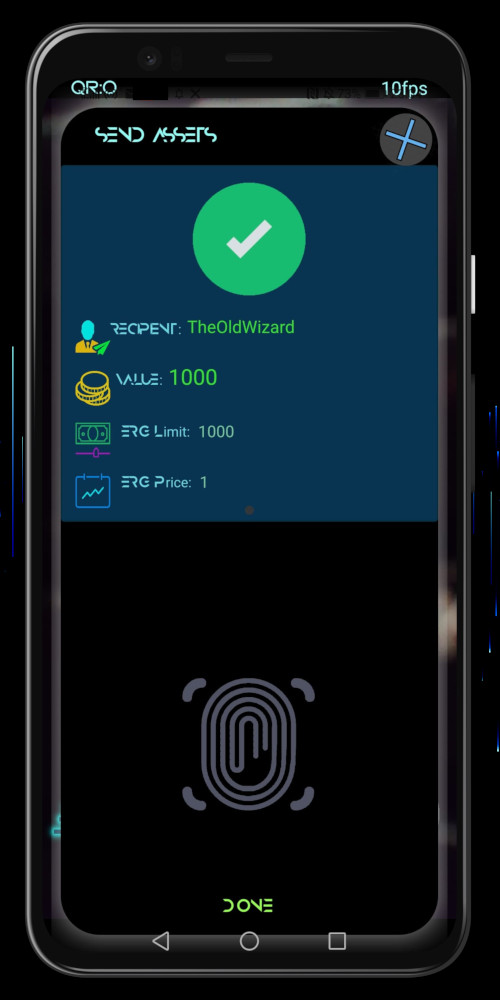
Success! Transaction made in just a few seconds!
One your transaction is delivered (usually takes a couple of seconds) to a random full-node you’ll see a graphical nicely animated notification like the one above.
Note: Currently the mobile app assumes confirmed delivery to full node and and the fact that it agreed to process the transaction after performing its initial validation as success. The transaction may fail or the block may be rejected by the decentralized consensus. This applied to any decentralized system (Bitcoin, Ethereum etc.) Thus it’s important to check the status of your account after a short while. In all likelihood though, once you see the animated confirmation, the transaction made it through like 99%.
As you might have read within the Wizards’🧙🧙♀️ Tome (i.e. the Whitepaper) the GRIDNET’s decentralized consensus employs a modified version of the Bitcoin’s NG protocol. What does that mean? Only good things.
- we get same same security is with Bitcoin
- we get incomparably more transactions per second than Bitcoin
- the amount of transactions per second is virtually unlimited, as same security guaranties
In Bitcoin a round-leader gets to confirm transactions. I.e. it is elected through a Proof-of-Work lottery and gets to pack a few dozens of transactions into a data-structure which is called a ‘block’. He gets to do this only once. He has just used up electricity of a large city or country just to get to confirm a single small set of transactions.
Doesn’t it feel like being ridiculously STUPID in the Bitcoin case? Well, guess what – it is.
We won’t be getting into the Bitcoin’s attempts at riding on the people’s lack of technical knowledge and the will to exploit and ride on their tendency to believe in abstract things and that’s a great subject for yet another article to come.
Stay safe and Happy Transactions! The 3rd of June Will be The Mobile Transactions’ Day!
Yours,
Wizards🧙🧙♀️
P.S
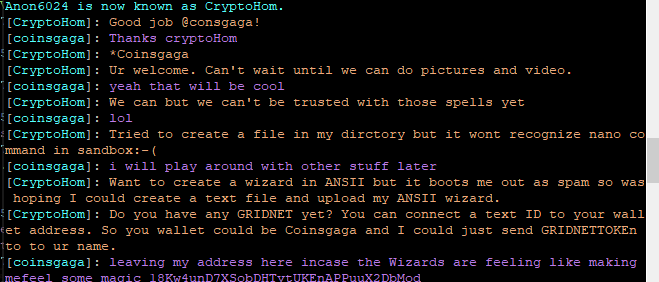
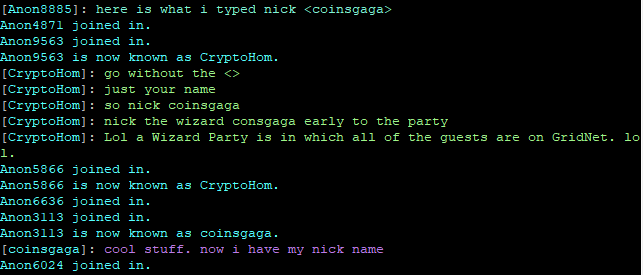
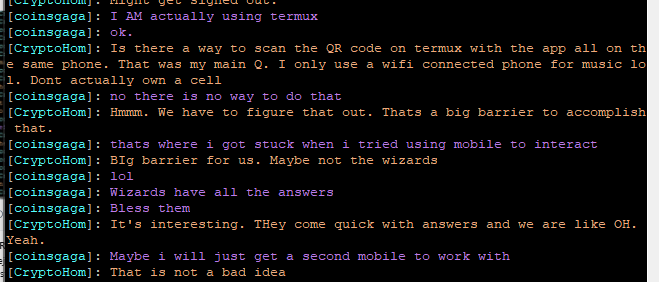
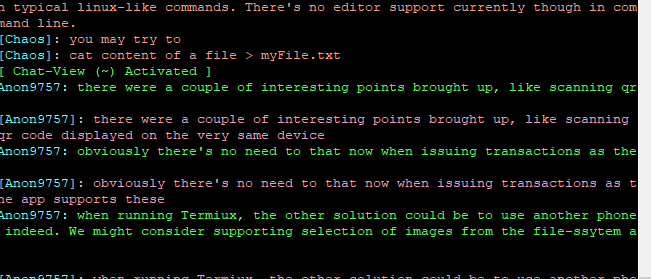
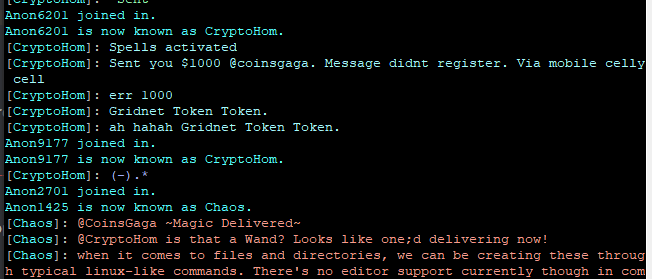
Below, screenshots of some of the funny moments from the Wizards‘ party we’ve been having yesterday evening on the GRIDNET-OS Decentralized Terminal (connecting over SSH). It’s a gallery you may swipe through 🤗