
The World That Remembers Everything:
An Infinite Player-Owned Multiverse in a Browser Tab
A GridCraft Field Dispatch
Owned by no company, remembered on a ledger no one can quietly rewrite, and tested by a machine taught to play it as a crowd.
⚠ Early Research & Development — Read this first
Everything described in this article is at an active, early research and development stage. GridCraft and the consensus mechanics it rides on are being designed, prototyped, and stress-tested in the open — and whether we ultimately manage to pull off everything laid out here is yet to be seen. What follows is a field dispatch from the middle of a difficult problem, not a shipped product.
We publish daily — often hourly — updates on our Discord #live-development channel as the work moves. Come watch us push, fail, learn, and try again.
I. A short history of worlds
For most of human history, a world was something you were born into and could never change. The mountains sat where the gods had left them. The rivers ran where they ran. You could name a thing; you could not move it.
Then, about fifty years ago, we learned to build worlds out of numbers. The first video games gave us landscapes to walk through — but switch off the machine and the world forgot you had ever been there. Your castle, your carved tunnel, your painstaking little farm: gone, or at best frozen in a save file on your own hard drive, a private reality no one else could visit.
Minecraft cracked something open. The block you placed stayed placed, and a friend could see it. But even Minecraft’s worlds are islands — a server here, a server there, each its own reality, each owned by whoever pays for the box it runs on.
GridCraft asks a stranger, more ambitious question:
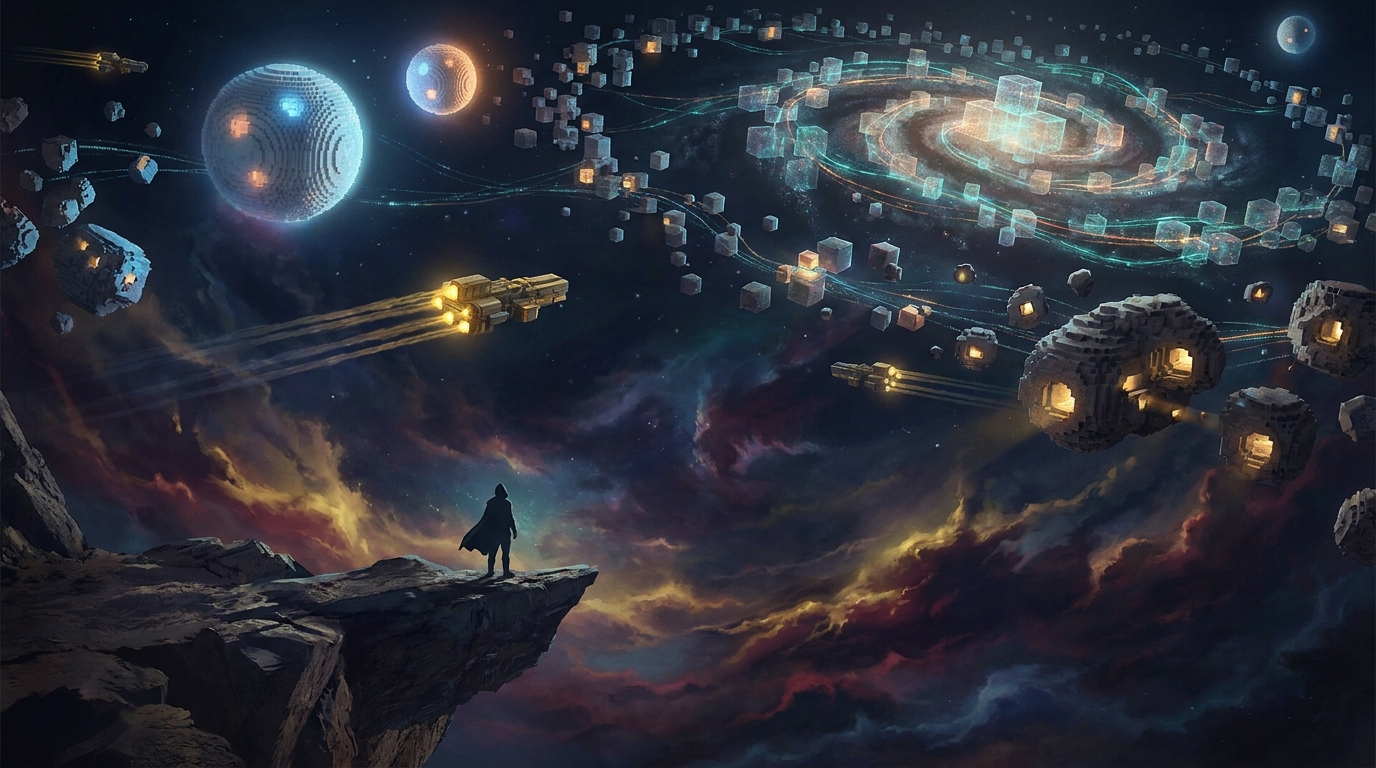
What if there were a single, infinite universe — one that every player shares, that no company owns, that remembers every block ever broken and every ship ever built, forever, on a ledger no one can quietly rewrite?
That is the dream. What follows is how the machinery actually works — and it is, we think, genuinely new.
II. Every grain of sand is a coin
Start with the smallest thing in the game: a single block. A cube of iron ore on some nameless moon.
In most games, that block is decoration. In GridCraft, it is money.
The rule is almost aggressively simple: one block equals one ledger unit equals one token. Swing your tool and break that cube of ore, and the world’s smart contract does two things in the same breath — it records that the block is gone from that spot, and it credits one unit of the matching resource token to your wallet. Place a block, and you spend one. Nothing is created from nothing; nothing vanishes into nothing. The universe obeys a law of conservation — enforced not by physics, but by cryptography.
This turns the entire landscape into an economy. A planet is not scenery; it is a vault. An asteroid belt is a bank. And because scarcity is real — only so many rich deposits, and mining capped per time-window so no one can flood the market — the things people need, fuel, rare minerals, the alloys that make a warp drive, acquire genuine value the honest way: by trade.
Ownership scales all the way up. A humble lantern claims a patch of ground around your home. Stake more energy and that patch becomes an estate; stake enough — the cost climbs with the cube of the radius, so empires are deliberately expensive — and you hold a planetary charter, a claim measured in continents and tradeable like a deed. From a single torch to a world, it is all the same substance: value, written down, that others must respect because the ledger says so.
III. The map that is never stored
Here is the first piece of real magic — the kind of idea that makes engineers sit up.
The GridCraft universe is infinite. Billions of star systems, each with planets, each planet a grid of billions of blocks. You could not store that. No blockchain in existence could hold it, and it would be absurd to try.
So GridCraft doesn’t store the universe at all. It stores the seed.
Every planet, every mountain range, every ore vein, every band of a gas giant is computed on demand from a single starting number, by deterministic mathematics. Give any two computers the same seed and they conjure the identical world, down to the last pixel, without ever having spoken to each other. The map is not a file. The map is a formula.
Which raises the obvious question: if the world is just a formula, how does it remember the tunnel you dug?
The answer is the quiet masterstroke of the whole design. The blockchain stores only the difference — only the places where a human hand deviated from what the formula would have produced. We call these deltas. Break that block of ore and the chain doesn’t store the planet; it stores a tiny note: at this coordinate, the block the formula predicts is now absent. Everything else is recomputed, free, from the seed.

Your game client, running in your browser, is forever doing this arithmetic: it regenerates the base world around you from the seed, then overlays the on-chain deltas — base plus differences — and shows you the result. It fetches those deltas continuously and asynchronously, only for the handful of chunks you can actually see. A planet edited by a million players costs you nothing until you fly close enough to read the notes for the ground beneath your feet.
It is, if you like, a universe that is mostly imagination and only occasionally memory — and it is exactly this asymmetry that lets an infinite world fit inside a finite ledger. (Hold on to that word memory. It has a price, and later we will meet whoever pays it.)
IV. The universe is woven from threads
Now the part that makes GridCraft a decentralized game rather than merely an online one.
GRIDNET is not a server. It is a decentralized operating system — a mesh of independent computers around the world, each running pieces of a shared machine. Inside that machine, work happens on Decentralized Processing Threads, or DPTs: sovereign little virtual machines, each running its own smart contract, each sequencing its own stream of events.
GridCraft carves the infinite universe into regions — a patch of a planet’s surface, a slice of open space, a docking station — and binds each region to its own DPT (which runs the world’s GridScript++ contract) and its own WebRTC swarm (a peer-to-peer mesh of the players who happen to be there). This gives the game two entirely separate nervous systems, and the difference between them is the key to understanding everything else.

The Presence Plane is gossip. Over the peer-to-peer swarm, your ship broadcasts where it appears to be, ten times a second, so the players around you watch it glide. This is what makes the game feel alive. But presence is never trusted. A rumor of a spaceship is not a spaceship.
The Truth Plane is law. Anything that matters — you broke a block, you bought land, you fired a weapon, you committed to a destination — is a call into the region’s DPT, executed by the GridScript++ contract, sequenced and finalized on-chain. Only the ledger decides what really happened.
Two facts about this plumbing sound almost contradictory, and both are true.

One browser reaches many nodes. As you move — across a planet, out into space, through a jump — your single browser tab quietly opens connections to many remote GRIDNET Core nodes at once, each hosting the DPT for a different region you can currently touch. You are not logged into “a server.” You are threading yourself through a constellation of independent machines, dropping and picking up connections as your interests move. The universe has no center to connect to; you connect to whichever fragments of it concern you.
Many players share one thread. When several players stand on the same patch of ground, they are not each talking to a private copy of the world. They all dispatch their actions into one shared DPT — a single GridScript virtual machine that serializes everyone’s moves into one deterministic order. If you and a rival both lunge for the same cell in the same instant, the shared thread picks a winner, and the ledger records exactly one outcome. Consensus, applied to a shovelful of dirt.

Modifying the world, then, is not a feature bolted onto the game. It is the game’s grammar. To break a block, to place one, to terraform, to deploy a settlement — each is a sentence spoken to the GridScript++ contract in that region’s DPT, and the contract writes down the delta the whole world will thereafter recompute against.
V. Who did that? — trust without a bouncer

If many strangers share one virtual machine, a hard question appears: when an action arrives in the shared thread, how does the contract know who sent it? A normal game checks your login. A DPT has no bouncer at the door.
GridCraft’s answer is a small, elegant cryptographic device: the Transmission Token — a stateless state channel.
Every meaningful action is wrapped in one — a compact, cryptographically signed credential that says, in effect: I, this specific identity, authorize exactly this action, and I have attached the funds to pay for the computation it costs. The signature proves who you are with no password and no session. The attached value incentivizes the network’s nodes to actually run your instruction — executing a stranger’s program is real work, and work deserves payment. And because each token is bound to one specific action at one specific position in your personal history, it can never be captured and replayed to forge a second move. Identity and incentive, sealed in a single envelope.
The shared DPT need not trust the messenger. It verifies the token, learns the true author, and only then lets the action touch the world. Ten players in one virtual machine, each unmistakably themselves, each paying their own way, none able to impersonate another — with no central authority anywhere in sight.
Now widen the lens, because this same signed token is the keystone of something larger.
In GridCraft, cheating is not detected. It is made structurally impossible.
You cannot lie about who you are, or replay a move: the token binds each action to one identity at one exact point in your history. You cannot lie about the world: the fast presence plane is never truth, so a client may broadcast that its ship is anywhere, doing anything, and it changes nothing — only a signed, sequenced operation edits reality. And you cannot lie about where you are: travel is priced lazily, charged from your last committed position to your next committed action, so there is no way to appear somewhere the ledger never watched you travel to. Teleporting is not against the rules so much as physically unavailable.

Then the hardest case of all: combat. In most online games a kill is decided in the heat of the moment, by whichever client’s packet arrives first — a paradise for anyone with doctored latency. GridCraft refuses to let the moment decide. Its model is closer to Clash of Clans than to a twitch shooter: a defender’s committed configuration — the ship’s build, its turrets, its shields, its standing orders — sits on-chain and auto-defends, awake or asleep, logged in or long gone. When you attack, you submit a signed action-log, and the contract replays it deterministically against that committed defense to compute the one true verdict. Latency cannot decide a kill; a client’s say-so cannot decide a kill; only the math, re-run identically by every node, decides. For those who crave a live, real-time duel there is an opt-in fast path that binds on a co-signed attestation from both combatants — and if either disputes the outcome, it falls straight back to the deterministic replay as the court of final appeal. An attester who signs a lie forfeits the staked GNC bound to their on-chain identity. Cheating, here, has a price the protocol collects by itself.
And the game has a quiet ethic of preservation baked into the same math: pilots always survive — the escape-pod doctrine says a defeated captain jettisons to safety no matter the outcome; and fledgling victims yield zero salvage, so preying on newcomers is contractually unprofitable. The universe has teeth, but they are pointed only at people who have shown up as genuine peers.
This is what we mean when we say anti-cheat is not a feature. It is a property of the cryptography — the very same signed token that lets ten strangers share one virtual machine is the thing that keeps the game fair. And it is what makes a genuinely decentralized multiplayer game possible at all.
VI. Energy, veins, and the land they sit on
Return to the smallest question the game asks of you: what does it cost to do anything?
The answer is energy — GridCraft’s platform-level currency of action, purchased with GNC and spent on every meaningful thing a player does. Every swing of a pick, every jump between stars, every square metre of land you claim consumes energy from the reactor of your ship or the wallet of your identity. Nothing you do in the world is free. And that is the design.
Movement is priced lazily. Travel through space is not, in itself, a transaction; it is not on the ledger. It becomes a cost only when you next act. At the moment of that next action — mining a block, docking with a station, opening a trade — the contract looks up your last committed position, calculates the fuel-time-distance to your new position under real physics (gravity wells, warp bands, black-hole ergospheres), and charges you the fuel it took to get there. Which yields a beautiful property: even if you somehow knew exactly where a rare vein of gold had just spawned, you still could not dart across the galaxy to loot it. The ledger charges you the whole trip from wherever it last watched you stand. Teleporting is not against the rules; it is simply physically unavailable.
Land carries a carrying cost. Recall the lantern from earlier. Plant one and it claims a sphere of ground around it, protected from other players. But the lantern burns energy — approximately the cube of its radius per key-block of the chain. Small plots are cheap; empires are ferociously expensive. Refuel your lantern and the claim persists; forget to refuel and the sphere winks out and the ground returns to the commons. Every lantern is tradeable in place — list it, sell it, transfer the deed, destroy it and reclaim the material. Personal plots ladder up to settlements, and settlements ladder up to planetary charters: continent-scale claims with public easements so no one can quietly enclose a whole world.
And veins move with the market. This is the piece we are proudest of. Rare deposits — most notably gold — are not painted onto planets at world-generation time. The world contract spawns them dynamically, and their count and richness respond to real market demand. When the on-chain price of gold climbs, more veins seed across compatible worlds; when demand cools, fewer respawn and existing deposits deplete faster than they refill. The economy is coupled directly to the geology. Positions are hidden until claimed (a commit-reveal so no one can front-run a spawn), and per-window emission caps — global and per-player — prevent any single actor from flooding the supply. The result is a map that moves: the mineral riches of a solar system rise and fall with the felt needs of the players inside it, and the surveyor’s job is never done.
Priced physics. Priced land. Priced discovery. Together they make the honest, playable universe that all of the earlier cryptography was setting the table for.
VII. Planets that bloom as you fall toward them
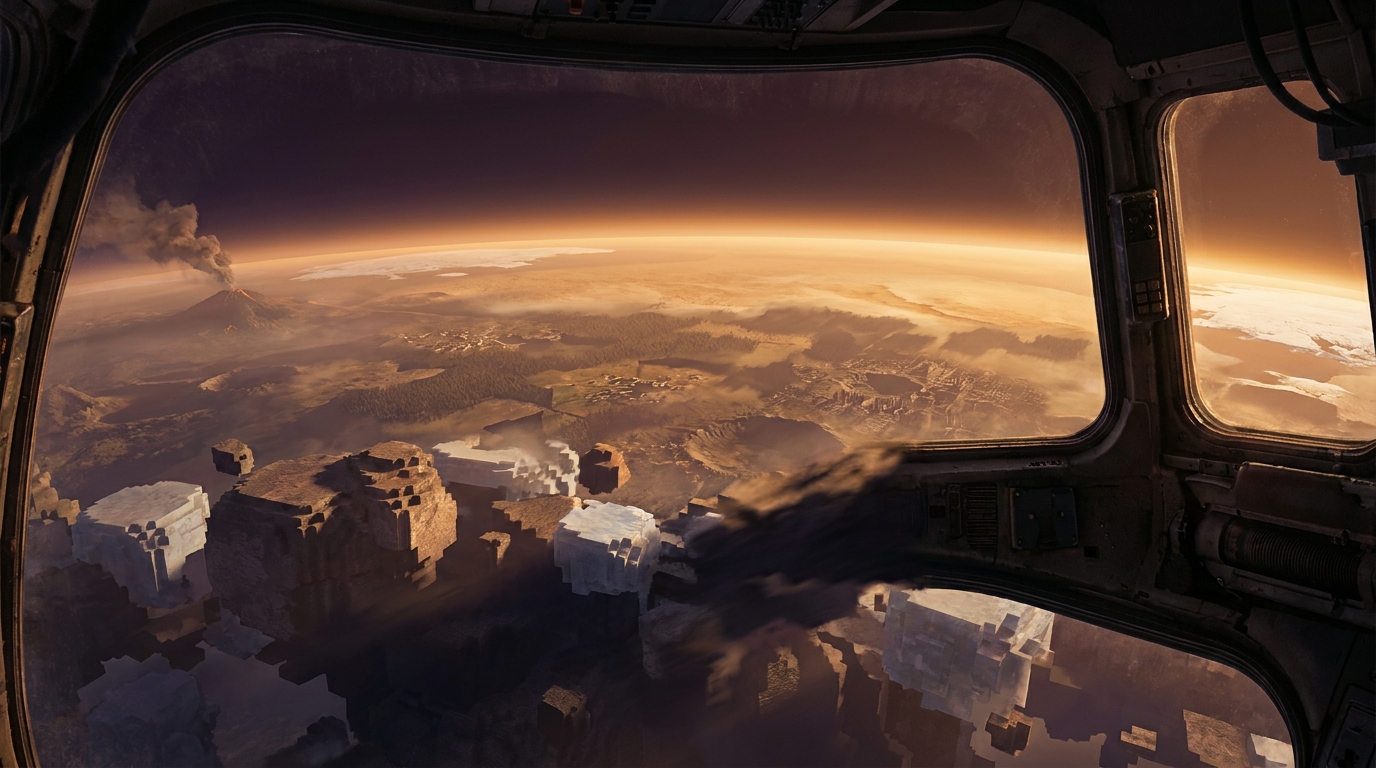

Enough machinery for a moment. Now for the part that is simply beautiful to watch.
A GridCraft planet is enormous — a surface grid up to tens of thousands of blocks on a side, over a billion columns. You obviously cannot draw all of it. So the game renders the way a human eye works: it shows you only what is in view, at only the detail you can perceive.
From deep space, a world is a single glowing sphere, sampled at low resolution from the true terrain, so its ice caps and equatorial deserts are already honest previews of the ground below. As you fall toward it, the sphere dissolves — through decimated regional patches, then into the real, breakable voxel blocks — in a continuous cross-fade with no loading screen and no jarring cut. Fly back out and it re-gathers into a globe. The mathematics guarantees there is never a visible “pop”: each level of detail fades to exactly zero as the next takes over.
And the whole time, a streaming governor loads and unloads the objects around you — stars, moons, asteroids, other players’ ships — within strict per-frame budgets, so a busy sky never stutters; at astronomical distances everything is compressed toward you in a way that preserves its apparent size while keeping the numbers small enough for a browser to handle.
Over all of it lies weather. Each planet has its own atmospheric identity — temperate blue skies with amber sunsets, sulfur-hazed volcanic worlds with ashfall, the banded storms of a gas giant, the honest airless black of a dead moon where the stars burn even at noon. And crucially, this weather is shared and deterministic: it is keyed to the blockchain’s own clock, so every player standing on that world at that moment sees the same gust bend the same grass, the same sunset, the same storm rolling in. Beauty, here, is not a private client-side flourish. It is another fact the whole network agrees upon.
VIII. The native powers of a decentralized operating system

Pause on something easy to miss in all this cosmic talk. Everything so far — the infinite universe, the shared threads of truth, the tokenized dirt, whole planets blooming as you fall toward them — is delivered to you as a web page. No installer. No engine to download, no console, no app store, no native binary of any kind. You open a tab, and an infinite, multiplayer, 3-D, on-chain universe assembles itself in front of you. That alone is a small marvel worth stopping for.
It is possible because GridCraft is not a program that uses a blockchain from the outside. It is a GRIDNET OS UI dApp — an application composed from the native organs of a decentralized operating system, the way a desktop app is composed from the organs of Windows or macOS. GRIDNET OS turns the browser itself into the operating-system surface: a windowing desktop with a taskbar and themes, inside which each dApp lives in its own sealed pane. GridCraft is one window among many. Here are the native powers it draws on, and why each matters to the dream.
- The desktop in the tab. Every dApp is a window with its own closed shadow-DOM body — a hard isolation boundary, so one dApp can never reach into another’s markup or styling. It reaches the node through exactly one door: a JavaScript object called the CVMContext, whose every call is an encrypted, self-describing request dispatched to a processing thread and answered asynchronously. GridCraft never phones a central server; it speaks only this native OS dialect — which is what makes an on-chain game a first-class citizen of the desktop rather than a bolted-on web embed.
- WebRTC swarms — the presence mesh. The OS gives dApps a peer-to-peer swarm layer: browsers finding one another directly, seeing who is online, and mutually authenticating — each peer proving, against its on-chain identity, that it is who it claims. This is the Presence Plane: ship poses ten times a second, gestures, chat, flowing browser-to-browser with no server in the middle. It is what makes a decentralized world feel populated and alive.
- Decentralized Processing Threads — the truth engine. Each DPT is a genuine virtual machine running GridScript in its own isolated copy of the world’s state-trie. Run an action in sandbox and it is a private what-if, never saved; commit it and the instruction is signed, broadcast, sealed into a data block, and re-executed on every node. This is the Truth Plane — the organ that turns a player’s intention into shared, sequenced, tamper-proof reality.
- The SQL API — structured, on-chain memory. GRIDNET OS carries a full SQL database engine, per-identity, stored encrypted and compressed on the decentralized file system — and byte-for-byte identical whether opened from a browser dApp or from a contract running inside a node. It is how the structured furniture of a world — records of ownership, land, the delta log itself — is written and queried on-chain. It is also exactly what the AI test harness’s oracle reads back, row by row, to grade the game against the ledger.
- The Compression API — memory kept small. Before anything is written to the chain, the OS squeezes it through a native compression layer. Payloads and database changesets go on-chain compact, in tight binary, not as bloated strings. This is the humble, essential half of “remembered forever, affordably” — the delta log stored economically before erasure coding ever spreads it thin.
- The Swarms API — messages that wait for you. Above the raw swarm sits an intent-shaped messaging layer with a three-tier delivery waterfall: try the live peer directly; if they are offline, leave the message cached in the swarm for later; and if it truly matters, seal it, encrypted, onto the chain itself. A dApp declares only how durable a message must be, and the OS runs the right path — replay protection and anti-spoofing baked in. It is how a crew invitation reaches a captain who is currently logged off.
- The Assets API — everything tradeable, natively. Tokenization is not something GridCraft implements; it is something the OS provides. A shared native program lets anyone mint assets with custom tokenomics, each token named by a deterministic fingerprint of its issuer, its name, and a nonce — so ore, fuel, land deeds, and ships are all first-class tokens the whole network understands. This is also what keeps the multiverse honest: because a token’s identity derives from who minted it, under which universe’s rules, v1-gold and v2-gold are simply different tokens by construction.
Step back and the shape is clear. GridCraft was not ported onto a chain. It is assembled out of the native primitives of a decentralized operating system — presence, threads, database, compression, messaging, assets — and served to you in a browser tab. The game is a demonstration, as much as an entertainment, of what those primitives can already do when you ask enough of them at once.
IX. The machinery underneath — keeping a universe affordable to remember
Return to the promise that started all this: a world that remembers everything, forever. It is a beautiful sentence. It is also, if you look at it the way an engineer must, a slightly terrifying one.
“Forever” has a cost, and so does “alive.” Every tunnel dug, every block placed, every ship built adds one more line to the on-chain record of differences — the deltas — and that record only ever grows. In the simplest blockchain design, every computer keeps every line of it, in full, and re-runs every action the whole world takes. A single shared diary is charming when a village writes in it. It becomes an impossible burden when a galaxy does — and no galaxy-sized diary, copied whole onto every laptop and re-read on every heartbeat, could ever feel fast.
So the question underneath the romance is the hardest one in the whole field: how do you let an infinite, ever-growing, permanently-remembered universe stay cheap enough for ordinary machines to carry and fast enough to feel alive — without surrendering to a central data-center that quietly foots the bill and quietly holds the power?
This is where GridCraft stops being a game riding on finished infrastructure and becomes something stranger: a reason for the infrastructure to grow. Its most romantic demands — an infinite history remembered affordably; a near-real-time feel on a machine that is fundamentally turn-based; ships and crews crossing region boundaries and even black holes without one global traffic jam — are a forcing function. They push GRIDNET’s consensus layer forward, and each new thing that layer learns to do widens what the game may dream next. The two are growing up together.
The heritage: a Bitcoin heart
To understand what’s new, understand what we refuse to give up.
GRIDNET’s consensus was, from the start, built in the lineage of Bitcoin — specifically the design the literature calls Bitcoin-NG. There is real Proof-of-Work mining: machines around the world burn real energy racing to solve a cryptographic puzzle, and the winner earns the right to lead. That leadership takes two kinds of block. A KEY block is the PoW lottery ticket — solving the puzzle elects the winner as the interval’s leader. Between key blocks, that leader streams out DATA blocks: fast, lightweight microblocks carrying the ordered flood of everyone’s transactions. Key blocks decide who leads, and for how long; data blocks carry the action.
This is the security bedrock, and it is not negotiable, because it buys three things nothing else buys as cleanly. To attack the ledger you must out-mine the entire honest network — attacks cost real-world energy, not just a large stake you already hold. There is no trusted validator set to bribe, capture, or subpoena; leadership is won, not granted. And the leader is trusted only to order transactions, never to decide what they do — every node re-executes every block and accepts it only if its own re-computation matches. A leader who signs two conflicting histories doesn’t fork the chain; he indicts himself, and forfeits his reward. This is censorship-resistance and costliness-to-attack of the kind that has kept Bitcoin standing for over fifteen years.
The marriage: an old heart in a modern body
Here is the thesis of everything that follows, and the reason GridCraft can exist at all.
We are not abandoning Proof-of-Work. We are marrying it.
The temptation, for a project chasing throughput, is to rip out the mining heart and replace it with a committee of well-capitalized validators — faster, yes, but you have quietly traded away the very properties that made a blockchain worth building. GRIDNET makes the opposite bet: keep the battle-tested old — real PoW, true to its security — and wed it to the daring new. Onto that mining spine we are grafting four of the most advanced ideas in modern consensus research: full sharding, optimistic roll-ups, erasure encoding, and data-availability sampling. The PoW chain remains the anchor — the thing that orders history and cannot be cheaply rewritten — while these new layers let the network execute in parallel, defer heavy work, store history without hoarding it, and prove data exists without downloading it all. Bitcoin-grade security and the throughput and storage economy a living, infinite, multiplayer universe demands.

Below are the four ideas in plain language — and a promise of honesty first. Today, in the shipped production network, every one of these upgrades is switched off, and the live chain behaves exactly like a classical, everyone-stores-everything, everyone-re-executes-everything Proof-of-Work blockchain. That is deliberate. Each mechanism is proven safe on internal test networks first, and each is built so that, when it is finally switched on at a coordinated network upgrade, it can only ever turn a “no” into a “yes” — accept something a full node would otherwise reject, never the reverse. Much of what follows is already validated on live multi-node test networks; some is still design and partial implementation. We will flag which is which. Consider this the honest state of the frontier.
1 — Erasure encoding: remembered forever, without asking everyone to remember all of it

Recall that word, memory. The record of everything players have ever changed only grows, and the naive rule — every node keeps a full photocopy — does not scale to a galaxy.
Erasure encoding breaks that rule with mathematics that has quietly guarded data for decades — the Reed-Solomon codes that let a scratched DVD still play and a deep-space probe’s signal survive missing pieces. The network shreds each block of history into a set of fragments — fourteen, say — sprinkled across many machines and engineered so that any ten are enough to rebuild the original perfectly. Lose four fragments — any four — and nothing is lost. A node no longer hoards the entire diary; it keeps a handful of fragments and still helps reconstruct any page on demand, transparently: a wallet or explorer asking for some ancient block gets the whole thing back, never knowing it was in pieces, quietly reassembled from shards scattered across the swarm.
The point, for an infinite world, is the “affordably” in remembered forever, affordably. History can be spread thin across the network instead of copied whole onto every machine. A self-healing loop even notices when a page’s fragments have grown too sparse across the living, churning network and re-scatters fresh ones before anything is truly at risk — and an erasure-coded fast-broadcast path lets a new block fan out through the network in shreds rather than flooding whole.
Honest status: the codec, the fragment-exchange protocol, the self-healing repair loop, and the shred-broadcast path are all built and validated on multi-node test networks, each behind its safety switch; the production default still keeps full copies. And candidly, this matters more in principle than in practice today — GRIDNET’s committed history is still tiny (megabytes), and a separate garbage-collector already shrinks the far larger live world-state by over 99%. Erasure coding is future-proofing, built ahead of the day a lived-in universe’s delta log grows large enough to need it. There is a lovely detail that shows the co-evolution at work: when GridCraft writes a record of who is aboard which starship, those bytes are ordinary signed transaction data — so they automatically inherit this same fragment-and-reconstruct scheme. Nothing special is needed to make a GridCraft record survive; the game simply rides the machinery it is helping to justify.
2 — Full sharding: a universe that thinks in parallel
A single shared computer that must process every action in the universe, one at a time, is a bottleneck the size of a galaxy. Sharding splits that one computer into many, each responsible for a slice, all running at once — and GridCraft’s map already draws the dividing lines. The regions we met earlier, each bound to its own thread, are the game-facing face of this idea: there is no good reason a mining dispute on a distant moon should wait in line behind a market trade two galaxies over.
The genuinely hard part is the boundary. What happens when a starship — crew aboard, cargo in the hold — flies from one region into the next, or dives through a black hole into a different universe entirely? A naive system would freeze the whole network to move one ship. GRIDNET’s answer is cross-shard atomicity: a change spanning two slices happens entirely or not at all — proven not by locking the world, but by the fact that every honest node, re-computing the crossing independently, arrives at the identical result. Value is conserved across the seam: the cargo that leaves one shard is exactly the cargo that arrives in the other, never duplicated, never lost, with no central coordinator refereeing the handoff. Elegantly, re-derivation itself is the proof — no two-phase commit, no watchtower, no receipt chain to trust.
Honest status: this is the most active edge of the whole endeavor, so precision matters. Today GridCraft’s world runs as a single consensus shard; its region threads are an application-level partition on top — not yet independent shards executing in true parallel. The machinery that verifies sharded execution trustlessly — a randomly-drawn committee whose two-thirds supermajority must agree, backed by any node’s ability to re-execute a slice it doesn’t even hold and check it against a compact cryptographic witness (the “stateless validation” lineage NEAR helped pioneer) — is built and validated on a five-node, four-shard test network, both directions: a correct block accepted, a forged one rejected. But the payoff — nodes safely carrying only part of the world, unlocking real parallel throughput — is not yet switched on; every production node still re-executes everything. And GridCraft’s fully-atomic “fly your ship across the boundary in one indivisible move” path is carefully specified but not yet activated. Today’s route is humbler: a clean handoff on one side, then onward through the finalized region on the other, the ledger watching every step so nothing teleports and nothing is conjured. The grand version is coming — built in daylight, one boundary case at a time.
3 — Optimistic roll-ups: anchor now, verify later
A game is a torrent of tiny operations — place, break, move, mine — many per second, per player, forever. Ask a secure base layer to fully execute and re-execute every one of those ticks on every machine and you have re-invented the galaxy-sized bottleneck. This is the tension optimistic roll-ups exist to resolve, and the piece that most directly reconciles “a fast game” with “a serious blockchain.”
The idea, borrowed from the frontier of the roll-up movement, is deferral. Instead of the main chain grinding through every GridScript++ operation the instant it arrives, a batch of state-changes is asserted and anchored onto the Proof-of-Work chain now — “here is the result I claim” — while the expensive verification is rolled up and settled a little later. The mining chain’s job becomes ordering and anchoring, not executing every game tick itself. Work is assumed valid, backed by a slashable bond the proposer forfeits if they lied, and a challenge window in which fraud can be called out.
GRIDNET’s version carries a distinctive twist worth savouring, because it makes the design unusually robust. In the classic optimistic roll-up, safety depends on a challenger showing up to dispute a bad result. In GRIDNET it does not: at the end of a short, fixed window every full node deterministically re-derives the result for itself, at the very same point in the chain’s history, and converges on the identical verdict with no messages exchanged at all. A challenge only accelerates the punishment of a cheat; it is never required for the ledger to stay correct. It is less a courtroom that waits for an accuser than a room full of auditors who all, independently and inevitably, redo the sum.
Honest status: the deferral machinery — including the atomic, value-conserving cross-shard batches from the previous section — is validated on the test chain (single-delta, multi-party, and general read-modify-write forms all proven end-to-end), with the production switch held off pending an architect-signed network upgrade. The first place GridCraft uses it is the humblest and safest: a player’s own on-chain progression — portable, self-sovereign reputation earned by playing — settled this deferred way from the player’s own account, already validated on the test chain, with the final in-browser hookup as the last mile. Richer, contract-emitted batches (a whole region summarizing a key-block’s worth of gameplay in one seal) await one more piece of plumbing that lets a GridScript++ contract emit its own roll-up batch; that is the next milestone, not a shipped feature.
4 — Data-availability sampling: trusting that the world is really there
There is one last trust problem, subtle and deep — the shadow cast by the three ideas above. If no single machine keeps the whole universe anymore — if history is shredded into fragments and the world split into slices executed by others — how can you, on your laptop, be sure the data your game is quietly reconstructing actually exists out there, and hasn’t been silently withheld? A dishonest publisher could announce “here is a new page of history” while secretly holding back the very pieces needed to read and check it. What you cannot retrieve, you cannot verify.
Data-availability sampling is the elegant answer — one of the most beautiful ideas in modern consensus. The block’s data is arranged into a two-dimensional grid and deliberately over-encoded with the same erasure mathematics, so that if even a small sliver is missing, a large fraction must be missing — there is no way to hide just a little. Now a light participant need not download the whole thing to be convinced it is all retrievable. It simply asks for a few random cells. If the data were being withheld, the chance that every one of those random probes happens to land on a still-available cell shrinks to almost nothing. Sample a handful, get them all back, and you can be overwhelmingly confident the entire page is out there — the same insight, pioneered by Celestia, that lets a phone trust a chain it could never store. For GridCraft, this is precisely what lets your client trust the base-plus-delta reconstruction it renders: it can satisfy itself that a region’s edits are genuinely available before it draws the ground beneath your feet.
The natural fit — a GridCraft-shaped fit — is that each region’s bundle of edits becomes its own namespace in that grid. A light client, or an operator who cares only about one corner of one planet, can then prove its patch of the universe is available and fetch exactly its own cells, without ever downloading a galaxy.
Honest status: the primitives are Celestia-class — the two-dimensional coded grid, namespaced retrieval proofs, an availability commitment anchored in the block header. But today the guarantee still leans on a trusted core-committee supermajority attesting availability, rather than the trustless ideal in which every client samples for itself and can overrule the committee. That per-client sampling lane, and the per-region namespaced serving GridCraft would use, are specified and partly built, awaiting a coordinated upgrade — the vision complete, the last mile (every client its own auditor) on the roadmap.
Why this is a two-way street
Here is the detail that makes the co-evolution concrete rather than poetic. Before committing to build the fancier machinery, we did the unglamorous thing and measured where the game actually hurts. The answer came back unambiguous: GridCraft is storage-bound, not computation-bound. Its dominant cost is not the physics of breaking blocks — it is the relentless accumulation of the delta log, that permanent record of everything every player has ever changed. Which is to say: the game’s true bottleneck is exactly the thing erasure coding and data-availability sampling exist to tame. The romance and the engineering pointed at the same spot on the map.
That is what it looks like when a game and the computer beneath it grow up together. GridCraft is the canonical worked example the consensus team reaches for when deciding what to build next — its ships and crews and black holes are why the boundary-crossing problem got solved, its swelling delta log why the storage problem got urgent. An old, proven, energy-anchored heart; a new, daring, modern body; and a universe that could not exist without both.
X. Guilds, and the ships they build
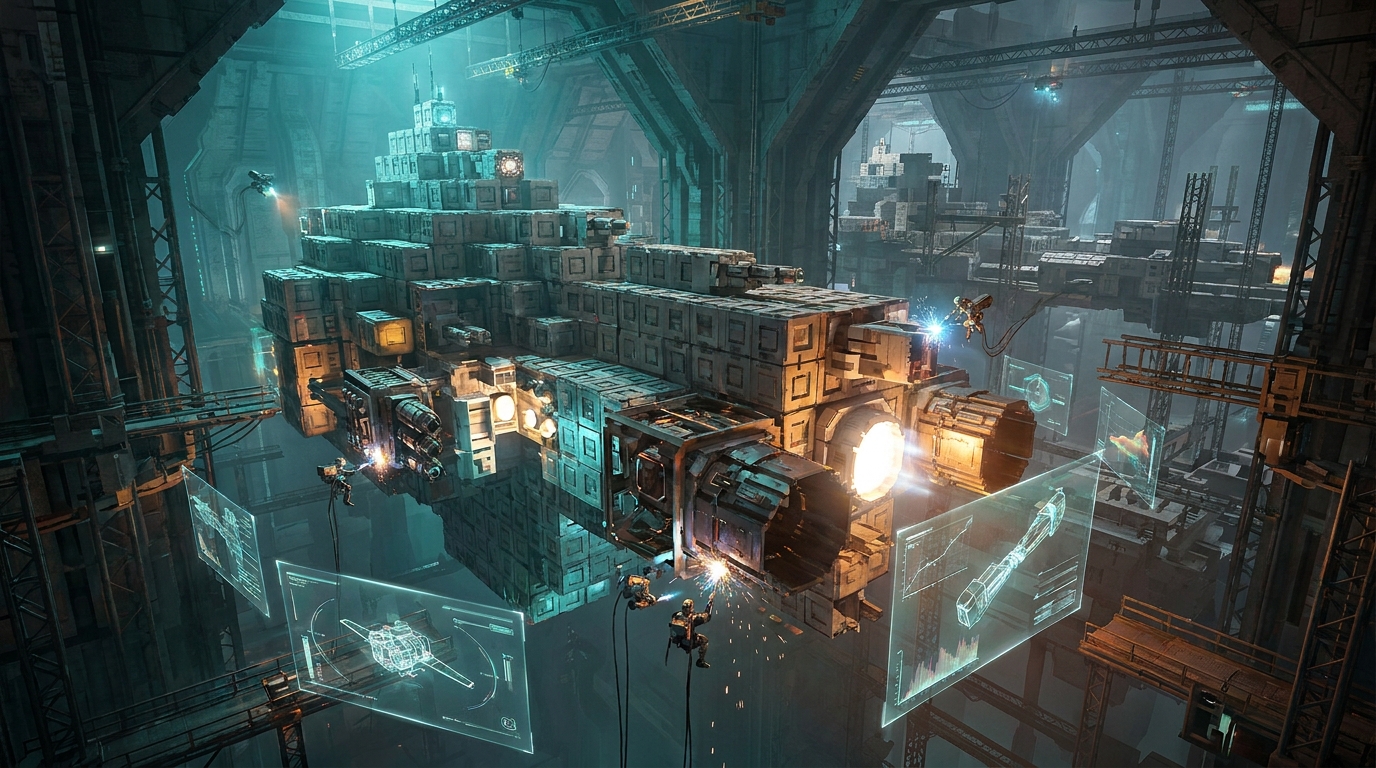
Players are social, and GridCraft gives their alliances real teeth. A guild is a first-class on-chain organization: you found one or join one, and inside it people hold ranked roles — founder, officer, member — where each rank is a cryptographic capability, not a cosmetic badge. A guild keeps a shared treasury that can hold assets in common, and a founder can hand the whole organization to a chosen successor.
What matters for a game set among the stars is that a guild can own starships. A vessel’s owner need not be a lone player; it can be the guild itself. Members then operate the fleet according to their rank, enforced by a signed membership attestation checked on every action: an ordinary member may fly, dock, and haul cargo, but only owner- or officer-rank hands may alter the ship’s structure — weld on a new weapon, tear out a reactor. Guild-owned fleets, a common war-chest, cooperative expeditions — all with roles enforced by signatures rather than trusted by convention. A pirate crew and a merchant consortium run on the very same rails; only their rules differ.

But a ship must first be built — and here the universe checks your work.
You do not buy a starship in GridCraft. You build one, on the honest supply chain the whole economy rests on. You harvest: break blocks, and the ledger credits the matching mineral tokens. You refine those raw minerals into alloys and components — a second class of tokens, worth more because work went into them. And you build: every ship module has a recipe, and assembling it debits the real refined tokens it costs. Nothing is conjured; a warp drive is expensive because the metal and the labor behind it were expensive.
A ship is a modular voxel machine, assembled from a catalog of parts — reactors, engines, warp drives, shields, weapons, cargo bays, life support — and the contract will not let an impossible one exist. Before your design is real, it is validated: are the modules structurally joined into one hull? Does the reactor make enough power for everything drawing on it? Does the heat balance? And the wonderfully concrete question — is there enough thrust to overcome the gravity of the world you’re standing on, or will this proud vessel simply sit there? You do all of it in an interactive in-browser Ship Yard: a 3-D workshop where you place modules by hand and watch live buildability feedback tell you what’s wrong, before you ever commit the finished hull to the chain. (A charming consequence of the rules: a docking station is just an anchored ship with no engines — so players build their own ports, too.)
XI. The exchange — everything is tradable
Because every gathered block and refined alloy is a first-class native token, GridCraft is not a game with an economy bolted on — it is an economy, and it turns in a circle. What one player mines, another refines; what one refines, a third forges into a hull; and all of it moves through GRIDNET’s on-chain markets.
Trade takes two shapes. There are automated market-makers — constant-product liquidity pools, the familiar swap curve of decentralized finance — where you exchange one resource for another at a price the pool sets from supply and demand, with no counterparty needed. And there is direct, peer-to-peer trade: hand cargo ship-to-ship in the dark between stars, or sell an entire starship through an escrow that releases the vessel and the payment to their new owners in the same atomic breath, so neither side can cheat the swap.
Crucially, there are no authored missions, no NPC quest-givers, no scripted rewards. Every incentive in GridCraft emerges — from genuine scarcity, from free trade, and from the rails players build for one another: a posted bounty, a hauling contract, an escrowed job. The economy is a living thing, not a list of chores.
XII. The multiverse, and the doors between
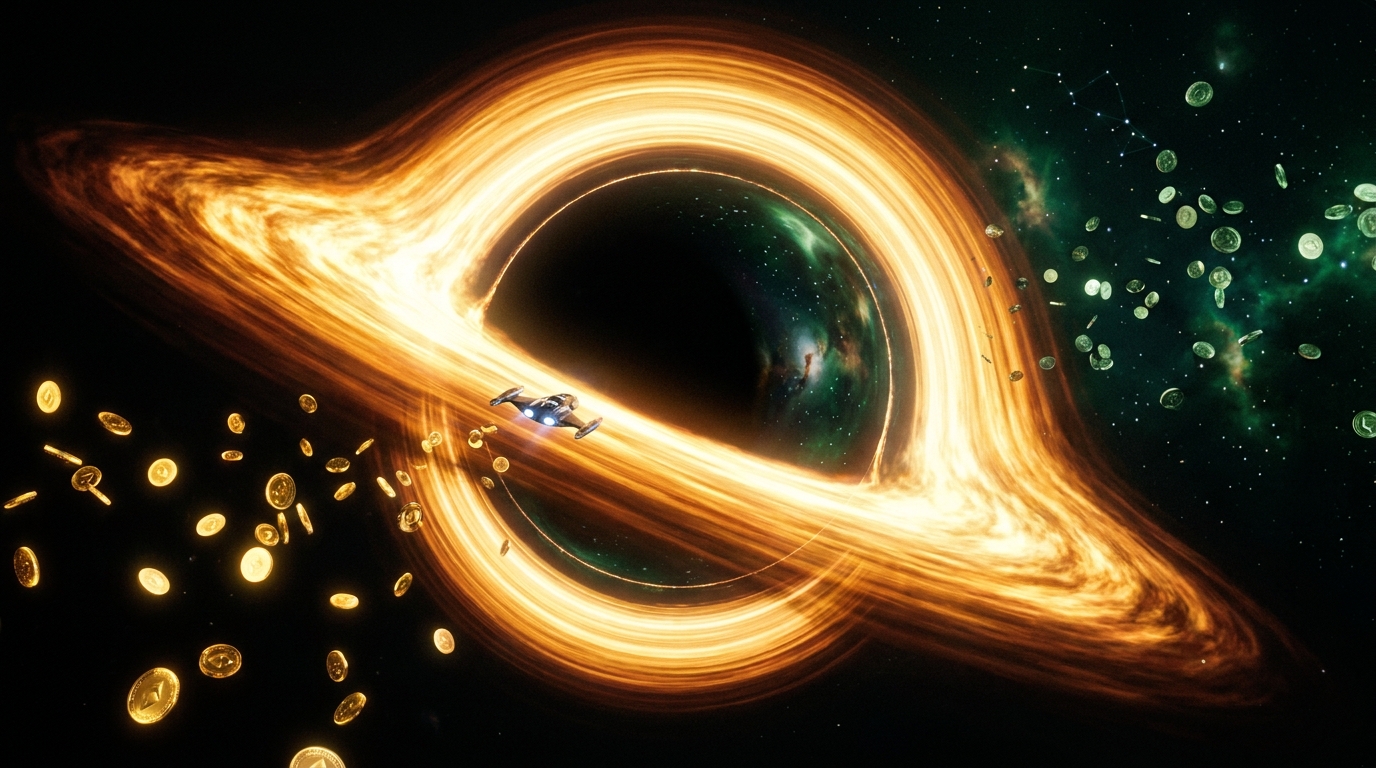
We set out to build one universe. We ended up needing many — and the reason is a lesson in humility disguised as a feature.
Our first universe will be imperfect. Its planet-generation, its physics, its rules for how life arises — all of it is a first draft, and we know it. The temptation would be to keep “patching” the live world. But you cannot rewrite the laws of a universe out from under the people living in it: regenerate the terrain and you destroy the tunnel someone dug last week; buff a mineral and you rewrite the value of everyone’s savings.
So GridCraft treats the multiverse itself as the upgrade mechanism. Each universe is a distinct deployment — its own seed, its own version, its own generation algorithms — and a better universe is never a patch to the old one. It is a new one, next door. And the doors between them are black holes.

Fly a starship into a black hole’s horizon and you fall through into a different procedurally generated universe — one whose seed is deterministically derived from the hole you entered, so the same door always leads to the same new world. Players will, in time, choose which universe to live in.
And here is the subtle safeguard that makes this safe rather than chaotic: your gold from Universe 1 is not the same token as gold in Universe 2. When value crosses a black hole it keeps its origin stamped into its very identity — this is v1-gold, minted under v1’s rules. If a bug in one universe ever let someone conjure infinite gold, the damage is sealed inside that universe’s token; it cannot silently poison the others. And what v1-gold is worth over in v2 is not decided by the code at all. It is decided, as it should be, by a market — an exchange where the currencies of different realities trade against one another. A multiverse, it turns out, needs foreign exchange.
XIII. Life that might, or might not, be there
The most speculative dream — and the one closest to our hearts — is life.
Many of us first felt the strange wonder of emergence watching Conway’s Game of Life as children: a few dead-simple rules on a grid, and out crawl gliders, oscillators, things that look uncannily alive. GridCraft is trying to marry that wonder to a blockchain. Planets can host organisms of water, land, and air, each grown from genetic vectors and governed by Game-of-Life-style behaviour bytes — deterministic so that every player standing on the same latitude, at the same key-block, sees the same herd trot along the same ridgeline. Ambient life is not a client-side flourish; it is another fact the whole network agrees upon.
The organisms behave like a real ecology, not a spawn table. A per-region population automaton tracks how much life a leaf of the world can sustain — hunt an area to exhaustion and it quiets and takes time to recover; leave it alone and it teems. Over-hunting is not punished by a rule that flashes a warning; it is simply followed by silence. The predator learns economics the way predators everywhere always have.
Stranger still, we are borrowing a metaphor from quantum physics: whether a specific creature is present in a place is not fixed until someone looks. The contract decides the probability of an encounter, shaped by the local population state and by whatever players have done there before. Observation collapses the possibility into a real encounter. Two people in the same clearing at the same moment resolve the same wolf, or the same silence, deterministically. Whether all of this is genuinely feasible at scale, we honestly do not yet know. That is precisely the kind of thing we are on air, live, trying to find out.
And the water moves, too. Each world carries a full deterministic hydrology: flow fields carved into the terrain, rivers and waterfalls that follow the honest gradients of the ground, drainage basins that gather themselves without a human placing them, ocean currents that pull the sea in slow circles, and tides that answer to a moon. Every player on the same shore at the same key-block sees the same tide roll in. Living things sit on top of a living planet — and the planet, too, is running.
XIV. Teaching a machine to play
Which brings us to the strangest and most modern part of this whole endeavor — and the reason a game is doubling as a frontier for computer science.
How do you test all of this?
A single-player bug is easy to catch. But GridCraft is multiplayer only, and its hardest questions are inherently social. Can one player deposit resources into another’s cargo bay? Can two people fly the same ship, one at the helm and one on the guns? When both edit the same block in the same instant, does the shared thread pick exactly one winner? Can you be attacked while logged off, your unattended ship a fair target in the dark? None of these can be answered by one person clicking around. They demand many real players, acting at once, on the real chain.
So we built something we find genuinely thrilling: an automated harness that plays GridCraft as a whole population of players — and fix what it finds.
GridCraft is developed, in the open, alongside frontier AI models. One serves as an architecture partner — holding this sprawling design in its head, reasoning about the trade-offs, writing the reference implementations. A second agent is turned loose as a tireless quality-assurance engine that does not merely read the code but plays the game.
Here is how the harness works, because the design is, we think, quietly novel.

It opens a handful of real Chrome tabs, each logged in as a distinct cryptographic sub-identity — a different player, with a different wallet, all standing in one shared world on a live test network. It drives each tab not by hand-writing scripts, but through a single standardized in-page control seam, so the AI simply composes the sequence of actions a scenario needs: player A mines, docks, and hands ten units of ore to player B’s ship.
Then it checks the result the way a skeptic would — twice, and never by trusting the player who acted. It reads the outcome back through a different, non-writer tab, and independently again through a REST/SQL oracle that queries the blockchain rows directly, outside the browser entirely. It captures the on-chain receipt at both the optimistic (dirty-local) and the finalized (sealed) stage, with the real transaction identifier. And — this is the discipline we insist on — it mocks nothing. Every peer is a real player. Every assertion is real chain state. The AI is playing the actual game, on the actual decentralized machine, and grading it on the actual ledger.
The result is a strange new kind of loop: a machine that reads the dream, plays it as a crowd, notices where reality diverges from intention, and repairs it — then plays again. It has already earned its keep. In a recent sweep it found that our own convenience feature for hiring a crew had quietly opened a theft vector — a hired hand could siphon the captain’s cargo into his own hold. The machine caught it; we drew the line where it belonged — crew may operate your ship, but only the owner may export its wealth — and the universe got a little more just.
XV. We are, right now, in the middle of it
Everything described here is real, and everything here is unfinished. We are, at the time of writing, deep in a general validation sweep — asking, mechanic by mechanic, the humbling question: is this dream actually enforceable by a decentralized state machine? Some of it is. Some of it we are still bending into shape. The boring, essential problems are as alive as the romantic ones — is the data stored efficiently, in compact binary rather than fanciful strings? Are the fairness rules airtight around the genuinely absurd edge cases, like several players riding one starship, holding a shared cargo, together, through a black hole?
We do not work from a roadmap. We work in the open — on YouTube Live, with daily notes on Discord, admitting it when the architecture is wrong and improving it when it breaks. The guiding principle is stubbornly simple: no crap down your throats. If it is broken, we fix it. If a design cannot stand the test of time, we say so, and we build a better one — perhaps, fittingly, in the universe next door.
What GridCraft is really testing is not a game. It is a proposition: that an entire, persistent, economically real world — infinite in reach, owned by no one, remembered forever, and now even tested by a machine that plays it — can run on a decentralized computer that belongs to all of us, and be handed to any player in nothing more than a browser tab. And in reaching for something that decentralized computer could not quite do yet — an infinite memory kept affordably, a real-time feel on a deliberate machine, a ship and its crew crossing between worlds — the game has been quietly helping to build the computer that can.
The game pulls the technology forward. The technology hands the game its next dream. That is the whole point.
We think it might work. Let’s keep building. ✨
— The GRIDNET Wizards. Follow the live development on YouTube and in the Discord Live-Development channel. This is a research-and-development project under active, daily construction; we will keep you posted, always, together.